Unfortunately, nasal tumors in dogs can cause significant destruction to the nasal cavity and carry a poor prognosis. To empower and comfort dog parents who are walking through this diagnosis with their beloved senior dog, integrative veterinarian Dr. Julie Buzby explains the types, symptoms, diagnosis, and treatment for nasal tumors in dogs. Plus, she discusses how to know when it is time to euthanize your dog with a nasal tumor.
When a lump or bump pops up on your dog’s skin, it’s usually pretty obvious. However, if the tumor is hiding in your dog’s nose, it’s a whole different story.
Often, a nasal tumor can grow in secret for several months before being found. And the initial symptoms are similar to those of allergies or an upper respiratory infection, so you may have no idea there is something far more sinister lurking in your dog’s nose.
Thankfully, nasal tumors aren’t super common—they only account for roughly one percent of cancers in dogs. But if your dog happens to have nasal cancer, that number probably doesn’t bring you much comfort.
What may help, though, is having a better understanding of what is going on with your dog. It can’t necessarily change the outcome, but it can help you navigate a nasal tumor diagnosis and know how to help your dog.
What are nasal tumors in dogs?
The term “nasal tumor” refers to any sort of abnormal growth that occurs in the nasal cavity. While nasal tumors can occur in any dog breed, they tend to be more common in dolichocephalic (i.e. long-nosed) breeds like Dachshunds, Collies, and Greyhounds.
And dogs living in urban environments also seem to be at a higher risk of developing a nasal tumor. This may be due to the increased exposure to air pollution which tends to accompany living in a major city.
Like many types of cancer, nasal tumors are more common in middle-aged to senior dogs, with the average age of onset being 10 years.
What are the types of nasal tumors in dogs?
About 20% of nasal tumors are benign growths such as fibromas or polyps. These tumors tend to stay on the surface of the nasal cavity rather than invading the bony structures. And they don’t cause nearly the damage that malignant tumors do.
The remaining 80% of nasal tumors are malignant. From most to least common, these tumors include:
- Adenocarcinoma
- Squamous cell carcinoma
- Undifferentiated carcinoma
- Fibrosarcoma
- Chondrosarcoma
- Osteosarcoma in dogs
These tumors tend to progress rapidly and are highly locally invasive. In other words, they can quickly enter and destroy the surrounding tissues. In some cases, malignant nasal tumors can even eat through the bone that separates the nasal cavity from the brain. Or they can damage the dog’s eye, cause facial deformities, or obstruct the dog’s airway.
Sometimes, in the later stages, the tumor can also metastasize (i.e. spread) to the lungs or lymph nodes. This is fairly rare, though. Most of the damage and the resulting symptoms are due to the initial tumor and its effects on the nasal cavity, eye, or brain.
What are the symptoms of dog nasal tumors?
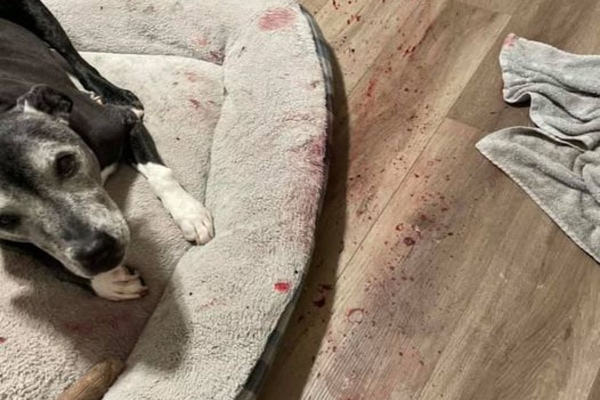
The tricky thing about nasal cancer in dogs is that the initial symptoms may be mild. For example, you might notice increased sneezing or reverse sneezing in dogs. At first, you (and your vet) might suspect that your furry friend has allergies or an upper respiratory infection.
However, these symptoms won’t go away on their own or fully resolve with allergy medicine for dogs or other treatments. And the dog might start to show other signs such as:
- Dog nose bleeds (i.e. epistaxis)—typically, the bleeding only comes from one nostril initially, but the nose bleeds may eventually involve both nostrils and increase in frequency and duration
- Nasal discharge, which may be clear, yellowish, reddish, or mucoid—usually only affects one nostril at first but may change to both nostrils as the tumor grows
- Decreased appetite
- Facial deformities (i.e. swelling, asymmetrical appearance, etc.)
- Loud or harsh breathing (almost like snoring or snorting)
- Difficulty breathing
- Being a lethargic dog
- Pawing at the face
Depending on how far the tumor invades, your dog may also have eye discharge, a bulging eye, or enlarged dog lymph nodes near the jawline. Or, if it spreads into the brain, the dog may experience blindness, abnormal gait, and dog seizure activity.
If your dog is showing any of these symptoms of nasal tumors, it is best to seek veterinary care. For dogs who are experiencing mild or non-urgent symptoms, you can make an appointment with your family veterinarian. But if your dog is having an uncontrolled nosebleed, difficulty breathing, or seizures, it may be best to make an emergency vet visit.
How is a nasal tumor diagnosed?
When you get to the vet, he or she will start by assessing your dog and gathering information from you about your dog’s history and symptoms. Then your vet will discuss the next steps with you.
Much more often than not, dogs with occasional sneezing or mild nasal discharge really do just have allergies or an upper respiratory infection. This means that initially, your vet may recommend trying symptomatic treatment.
But if the dog doesn’t improve as expected, or symptoms worsen, it may be time for additional diagnostics. Or, if the dog has more severe signs, the vet may recommend further diagnostics right away.
Unfortunately, the nasal cavity is harder to evaluate than many other areas of the dog’s body. The majority of it is enclosed in the bones of the skull. And the nasal cavity is filled with many scrolls of bone (i.e. turbinates). This can make it difficult to know what is going on inside.
Imaging
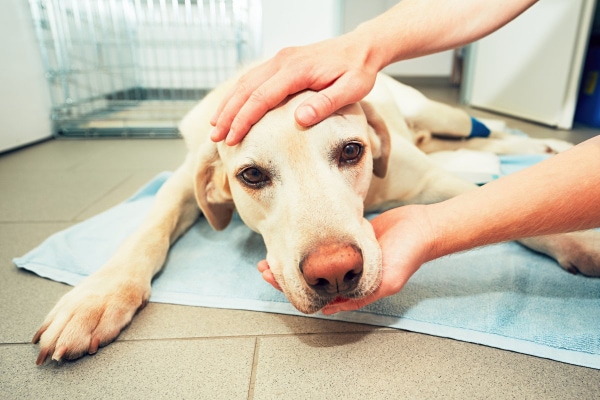
Sometimes, X-rays of the skull and nasal cavity can help diagnose a nasal tumor. But in general, advanced imaging such as a CT scan or MRI is more likely to be diagnostic. CT and MRI are more detailed than X-rays. And they provide cross-section slices of the area of interest, which is especially helpful when looking at a complex bony structure like the nasal cavity. (The skull structures are superimposed on one another on an X-ray, which makes interpretation challenging in some cases.)
Rhinoscopy
While it may not be able to detect quite as many nasal tumors as CT or MRI, scoping the nose (i.e. rhinoscopy) is another good diagnostic option. It often allows the vet to visualize the tumor and collect biopsy samples. Plus, it may be able to rule out other nasal issues like fungal infections, foreign bodies (like foxtails in dogs), or sinusitis.
Biopsy
The best way to determine if a mass is cancer, and the type of cancer, is to perform a biopsy (i.e. collecting a sample of tissue) and histopathology (i.e. examining the tissue under the microscope).
A study of 117 dogs with nasal cancer indicated that blind biopsy (i.e. performed without being able to directly visualize the tumor), advanced imaging-guided biopsy, and rhinoscopy-guided biopsy were all equally effective at diagnosing nasal tumors. This means there are a variety of ways that the vet can collect the tissue for the biopsy, depending on your dog’s particular situation.
Additional testing
The vet may also recommend a clotting panel. This can help decrease the chances that the biopsy site would bleed uncontrollably. And it also rules out a clotting disorder as the explanation for the dog’s nose bleeds.
Additionally, your vet may suggest chest X-rays to look for metastasis (which is rare but worsens the prognosis). Or he or she may want to perform a chemistry panel, urinalysis, and complete blood count (CBC) to get an overall picture of your dog’s health.
What is the treatment for nasal tumors in dogs?
After receiving the nasal tumor diagnosis, some dog parents decide to consult with a veterinary oncologist to pursue treatment. And others prefer palliative care options (i.e. ways to keep their dog happy and comfortable for as long as possible). This is a personal decision, and there isn’t one right or wrong answer.
Radiation
Should you choose to treat your dog’s nasal cancer, the veterinary oncologist will most likely recommend radiation therapy. This involves using focused high-energy particles or waves to destroy targeted cells (in this case, cancer cells). Although there is no definitive cure for nasal tumors in dogs, radiation therapy is the best way to achieve clinical remission (i.e. the cancer goes away for a certain period of time).
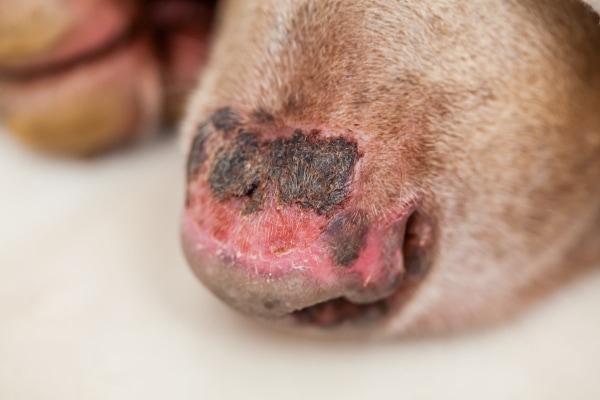
However, because of the high dose of radiation necessary for this kind of treatment, your dog may experience side effects such as:
- Redness or inflammation on the skin and in the mouth
- Peeling skin where the beam was directed (sort of like a sunburn)
- Conjunctivitis, dry eye in dogs, or even blindness due to retinal damage or the formation of cataracts in dogs
Palliative radiation
Interestingly, lower doses of radiation are also an option for palliative care. Several studies have indicated that palliative radiation can help decrease tumor symptoms.
Chemotherapy or surgery
While there are a few studies looking at chemotherapy for nasal tumors, at this point it isn’t typically the treatment of choice. Additionally, surgical debulking of the tumor may help improve some of the clinical signs, but it doesn’t improve survival time for dogs with nasal tumors. And these dogs typically still need radiation too.
Pain control
Many dogs with nasal tumors can benefit from anti-inflammatory or pain medications as well. The vet may recommend a non-steroidal anti-inflammatory drug (NSAID) like carprofen. Or he or she may prescribe a steroid like prednisone for dogs if the tumor may be affecting the brain. While not anti-inflammatory drugs, gabapentin for dogs or tramadol for dogs can also be helpful for reducing any pain associated with the nasal tumor.
Holistic treatment for nasal tumors
The herbal supplement Yunnan Baiyao for dogs seems to have an almost magical ability to stop bleeding. This means it can provide a holistic way to help prevent or manage nose bleeds in dogs with nasal tumors. Your veterinarian, or a veterinarian who is familiar with Traditional Chinese Veterinary Medicine (TCVM), can help you figure out a Yunnan Baiyao dose and frequency that is right for your dog.
Phenylephrine
Nasal phenylephrine drops may help minimize the inflamed tissues within your dog’s nose. Plus, since the medication constricts small blood vessels, it may also help with nosebleeds.
Keeping the house cool
Dogs rely on their airways to keep themselves cool, and nasal tumors reduce the efficacy of those cooling mechanisms. Therefore, leaving the temperature low in your home can reduce the risk of your dog overheating. Otherwise, without the ability to efficiently exhale warm breath, a dog can suffer heatstroke in dogs. This is a life-threatening emergency.
Also, anecdotally, many parents of dogs with nasal tumors feel that letting a fan blow cool air onto their dog’s face can make a big difference in overall comfort.
What is the life expectancy for dogs with nasal tumors?
Unfortunately, the long-term prognosis for dogs with nasal tumors is poor. Radiation therapy gives dogs the best life expectancy, with the potential of going into remission for one to two years. Additionally, palliative radiation typically decreases clinical signs in 65-86% of patients for 120 to 300 days.
Otherwise, dogs who receive no treatment may have a life expectancy of two to three months before the clinical signs become an insurmountable problem. However, untreated dogs with nose bleeds typically have a shorter life expectancy than this.
How will I know when it is time to euthanize my dog?
Because of the locally invasive nature of this cancer, and its ability to progress rapidly, I always advise dog parents to keep a close eye on their dog’s quality of life. It can be helpful to regularly fill out a quality-of-life scale for dogs. And you will want to watch closely for difficulty breathing, severe or frequent nose bleeds, blindness, seizures, or signs your dog is in pain. All of these can be indicators that it is time to prepare for your dog’s euthanasia.
I know it is never easy to face the loss of your sweet dog. And having to make that decision can weigh heavily on your mind. While I can’t tell you when it is time to let your pup go, I do want to offer several resources to help you with the journey:
- Dog Hospice Care Can Bring Peace and Dignity to Your Dog’s Final Days
- In-Home Dog Euthanasia: Heartfelt Answers to 12 FAQs
- Dog Euthanasia: Knowing When to Say Goodbye
- How Will You Know When It’s Time to Euthanize Your Dog?
- Grieving the Loss of a Dog After Euthanasia (& Finding Peace)
- Dog Memorial Ideas
Plus, your veterinarian or veterinary oncologist can help you through this trying time. Don’t be afraid to reach out and discuss your concerns or ask questions. That’s what they are there for.
Treasure the time you have
If I could leave you with a final parting bit of advice, it would be this—treasure the time you have. Unfortunately, nasal tumors don’t have a happy ending most of the time, and that can be hard to face. But you can choose to do your best to push through the sadness and find joy in the days you do have with your dog.
Spend some extra time hanging out on the couch together. Go to all of your dog’s favorite places. Make a bucket list for your dog and see how many things you can check off. Hire a photographer to capture beautiful pictures of the bond you have with your dog.
These are just some ideas to get you started. I don’t know what treasuring time looks like for you. But I do know it is worth figuring out.
Did your dog have a nasal tumor?
Please share his or her story below.


My 9 year old German shepherd/Rottweiler Dana mix got a bad nosebleed in February of 2025. My vet told me to bring her to Emergency vet right away. I did, it was a small clinic and after an Xray, told me there is something deep in her nose that must be dealt with asap. Referred me to another clinic an hour away for a CT scan . She ended up there for 2 days until they stopped the bleeding and diagnosed her with stage 4 nasal Chondrosarcoma. Vet said if she didn’t get a nosebleed, I never would have known until she had seizures which would have been the end.
There is only one treatment, stereotactic radiation and not many places in my area do it. None in fact. I had to travel over 2 hours to find an animal hospital. They felt she had a good chance at defeating it, so we went ahead. The cost was unbelievable; I did have pet insurance which helped. It requires 3 treatments in 3 days. She made it through very well. She had a lot of bloody nasal discharge for 3 weeks after. Then she was back to herself. Loves to eat, go for walks etc. She has to have a CT scan every 3 months to make sure it wasn’t growing again. The first one went well. Though it hadn’t been eradicated, it was dormant. We had a great summer with her and then the next CT showed it was back with a vengeance. Vet said she has 1-4 months, take her home and love her, keep her comfortable. She has been on Prednisone for 74 days now. Also switched her to fresh pet food last August, supplemented with mushroom powder, Broccoli sprouts, turmeric golden paste, sardines. Still active and eating. Yesterday she got a bloody nose, gave her the Yunnan Baiyao, breathing is getting difficult. Started using both vaporizers and air purifier. For when it’s time, I contacted a vet that will euthanize in my home and then cremate. She is my best friend, my other dog will be devastated.
I’ve had dogs all my life, 60 years, and never experienced anything like this.
Dear Jackie,
My heart aches for you as you spend these final days with your beloved girl. I applaud you for all you have done to fight this terrible cancer and give your pup the best chance for an extended remission. I am certain she knows how much she is loved and think it is wonderful you are planning a peaceful goodbye at home. Wishing you strength and comfort for the difficult days ahead. Bless you and your sweet girl.
UPDATE! It is now mid February 2026, a little over a year since diagnosis for Danas’ stage 4 Nasal Chondrosarcoma and she is doing very well! We have passed the 1-4 months she was given in September, so I made an appointment for another CT scan in a few weeks. It’s like she is totally back to normal. She eats, drinks, plays, loves long walks. She does still have some nasal discharge, but no blood.
I credit the fresh dogfood, mushroom powder, turmeric paste and garlic, and cutting out most carbs in addition to the radiation for this transformation.
I realize this is borrowed time, but I will take every second of it. Her 10th birthday is in March and I can’t wait!
Hi Jackie,
This is such wonderful news!!! Thank you for the great update. Praying for Dana’s continued success and keep up the good work!
My dog starts radiation for his nasal carcinoma this week. Please send your recommendations for (“the fresh dogfood, mushroom powder, turmeric paste and garlic, and cutting out most carbs.”) I’m ready to do anything.
hi, can you please tell us what Fresh dog food you used and which mushroom powder? We will Pray that you continue to have good quality times with Danas, we feel you so much what you are going through! Thank you.
My 11 year old Wheaton (Teddy) has a nasal tumor that is getting worse and I’m afraid we’re close to the end. He’s had bloody sneezing for months and started snoring loudly but he was playful and happy most of the time. He’s had several bloody episodes that were very scary and he’s been on Chinese herbs, a steroid and relaxation meds to help but his breathing is getting worse and there’s lots of nasal discharge dripping and bloody sneezing. I’m try to keep him comfortable but I’m so nervous that I won’t be home if he has a bad sneeze and I can’t help him! This is so hard but I might have to let him go if he’s suffering but I’m dreading that day.
Hi Nancy,
I’m so sorry to hear that Teddy has a nasal tumor that is getting worse. Watching our dear companions decline and knowing the end is approaching is so heartbreaking. I understand well your fear of him having a bad episode when he is home by himself. There tends to be a window of time in which euthanasia is the right choice. Some people may decide to let their dog on go a good day, before something like a big nose bleed happens. Other people decide to wait a bit longer in that window because the benefit of more time together outweighs the potential risk of having to make a decision for euthanasia on a bad day. Neither approach is right or wrong. It is just a matter of figuring out what feels right for Teddy and right for your family. I can’t tell you when that is, but I do want you to know that my heart goes out to you in this challenging time.
You may find some of the resources below helpful:
1) Using a Quality of Life Scale for Dogs — Regularly filling out a QOL scale can be a great way to track changes over time and gives you an objective look at the situation.
2) Preparing for Your Dog’s Euthanasia: 10 Thoughts for Peace
3) Pet Loss Support: Groups & Resources for Comfort
Our Border Collie Kelt has a nasal tumour. He was 7 years old when diagnosed.
He had a rough start to life before we adopted him at 2yrs old. He was scared of people, especially men and it took a couple of years for him to realise life was great and he could trust the closet humans around him. He became my running buddy, a real goofball and a Mummy’s boy.
Kelt’s first symptom was a blocked tear duct and then a month later there were increased reverse sneezing and a nose bleed. After that he went straight for scans where a nasal tumour in his right side had eaten into the bones and filled all the spaces available. It had not reached the brain and missed the eye socket and had not spread any further down his body.
The tumour was so extensive in his nasal cavity that the vets said he had between two weeks and three months to live. We chose not to have a biopsy as we were told that there was a high risk of bleeding and chemo would not extend his lifetime enough for it to be worthwhile.
A treatment of Pardale and metacam seemed to keep him pain free and happy. In fact we wonder how long he had been in pain for before then as he became so much more confident and loving around people, has become besotted by my husband at last, and just seemed an even happier dog. We did wonder if this had been going on for years but advised that it wouldn’t have been but I still do wonder.
So we enjoyed every moment we had and did what he wanted to do. He stopped wanting to go for runs but still loved his walks and most of all visiting beaches and playing with his ball. We found a chuckit ball that gives a little when he catches it and is hollow with spaces so he could breathe more easily when he carries it. It was a gamechanger for him to keep enjoying his favourite activity. Sometimes he had tumour bleeds and occasionally nose bleeds but he didn’t seem bothered and we could manage along with the reverse sneezing.
You would have never known that he was unwell and under end of life care enjoying running around and playing apart from the bump that started to grow up between his eyes.
So at 12 months we were celebrating with his other favourite activity – ripping open cardboard boxes and wrapping paper to reveal new toys.
2 weeks later something has changed and over night his face has become swollen. Some meds have helped reduce the swelling and we have been given the all clear for another trip to the beach but with restricted exercise. We are hoping it is just a blip but we do know that our time will soon be up so we are going to make sure this is his best adventure yet!
Dear Holly,
My heart goes out to you as you prepare to spend these last days with your beloved Kelt. It sounds like he has lived a wonderful life, full of adventure and joy. I hope your beach trip is amazing and pray your pup will enjoy every moment. Wishing you peace. Bless you and your sweet boy. ♥
Thank you for your kind words and thank you for this very informative site. I wish we had found it earlier.
Well we have now reached two years since diagnosis. The tumour has progressed y coming out of his face and between his eyes. Unfortunately it is now staring to compromise his breathing more at night.
However, He is still enjoying life! He is happy every morning, eating, drinking and keeping on his weight. He still enjoys his walks although the length of these have reduced and prefers to have ball time.
We know he can’t have much more time left as it has now been over two years.
Hi Holly,
Thank you for this update! What a blessing that Kelt has been gifted with so much time since his diagnosis. He is very lucky to have you taking such good care of him and monitoring his quality of life. Continuing to pray for comfort and that you find joy in each day. ♥
I am so sorry you are going thru this. We lost our Bolt (Border Collie and my heart dog) last month. He started with nose bleeds and on his last day horrible nose bleeds we could barely stop. He had a long history of epilepsy, arthritis and problems with blood pressure while under anesthesia. Our vet was pretty sure that it was a nasal tumor and trying to confirm this diagnosis would have put him in possibly a bad situation and uncomfortable. At 12 1/2 years old we chose to let him go before things got worse and we never wanted to see him suffer. I miss him terribly everyday and have faith I will see him again. I pray he is running and playing in heaven as happy and free as his puppy days.
Hi Darlene,
My heart goes out to you on the loss of your heart dog Bolt. You made a compassionate and loving choice to set him free from his ailing body, but even knowing that, it is still so hard. What a beautiful picture to think of him running and playing again like a puppy. ❤️
our 13 years Indian spitz was started with runny nose and reverse sneezing. Was treated for allergies for 6 months. Another vet detected blood in her nasal discharge. He declining daily. I know the end is near.
Dear Nitin,
I am sorry your dog is declining rapidly, and he is nearing his final days. Wishing you all peace and comfort as you prepare to say goodbye. ♥
Abby, our yellow lab, was checked by our local vet for sneezing repeatedly, with nothing seen in her right nostril. After a couple more weeks of more sneezing, we went to the “big city” vet hospital where she was biopsied and diagnosed with soft tissue sarcoma in her right nostril. That was January 2024, and she was a bit over 4 years old. Since then, 2e have used Yunnan Baiyao orally when her bleeding does not stop with pressure applied and head raised. We have given her (3)Stamets 7 (multi mushroom capsules) with her carprofen daily and Fenbendezole liquid (2Xday on her food). We have days with more bloody sprays, mornings now always begin with several minutes of “sneezing”, her energy is normal (happy, running, playing), appetite is normal, clear or darker liquid leaks from her right eye, some spots on the side of her mouth, but she lives her life as always. Much loving, naps together, exploring on our ranch, scavenging apples from under the trees, stealing blackberries from the vines…so very grateful we have had her this long, with this disease. Thank you for your compassion for the animals, and their owners.
Hi Jeri,
I am sorry Abby is living with this difficult cancer. What a blessing she has been able to maintain for so long since her diagnosis. Thank you for sharing your story with us as I am sure it will offer hope and support to others. Praying for continued success and happiness for your sweet girl. Bless you both.
My girl Poppy is near the end of her time. The tumor she has started in one nostril has grown to the other nostril; now she is having difficulty breathing as she sleeps. I never had a biopsy of the growth, the choice I made not to allowed her to be more comfortable after the scope of her nasal passage. The doctor gave me his educated opinion and that was enough to chose to keep her comfortable for as may days as we would be blessed to have her. So we medicated Poppy with pills for her pain, infection, bleeding, and congestion. Her face has slowly and every so slightly changed shape about her eyes and forehead, it looks like there must be internal pressure. This has been a journey caring for her these last eight months. I am in awe of her ability to be her happy go lucky self each day. I am so very grateful for each day I have her to love. I am going to struggle tomorrow when the good doctor concurs I must be brave and help my beautiful brave girl cross over. I must and will do what is best for my girl Poppy.
Dear Julianne,
I am so sorry Poppy is nearing her last days. What a blessing you have been able to make the most of these past few months together and that Poppy has remained happy despite her diagnosis. Praying for your strength as you face the emotional choices ahead. Bless you and your sweet girl.
Hi, our beautiful 7 and a half year old German Shepherd passed away on Friday just gone. Only last week I was playing frisbee with her, and then on Monday night she threw up quite Violently and took probably 15 min to look like she was going to stop being sick. She ate dinner afterwards and acted normally but the next morning clear key wasn’t well so we took her to the vet. At this stage her symptoms were all very Bloat like with the exception of the fact she was eating and pooping normally. The vet took heaps of x-rays and was convinced she had Gastro as her stomach was quite distended.
She came home that night with lots of drugs for pain and nausea. Her bloodwork showed elevated liver enzymes… but nothing really unusual. The next day we gave her the medication and other than occasional reverse sneezing and gagging she was ok… though she did walk head first into the wall twice. I put this down to the painkillers because they were sedatives.
The next day she threw up again and was clearly not well. She walked into the wall again and while was still very interested in eating she was having trouble walking properly. Another vet trip in the morning and we came back with antibiotics. She never got to take them because about an hour later she had a seizure. We took her back to the hospital and the admitted her with the intention to watch her for 24 hours. By the next morning she was in a constant state of seizure and was on muscle relaxants, we went down there as a family and spent some time with her before we put her down. I really hope she knew we were there for her.
So, she had been having bouts of reverse sneezing over the previous maybe 2 months. It was not regular or even often, I maybe saw her do it twice a day? I mentioned it to the vet when I took her in for her annual about 4 weeks ago but she wasn’t worried by it.
We think that she had developed nasal cancer that caused the reverse sneezing and then in the space of a week the neurological symptoms emerged.
I only wish I had been more proactive about the reverse sneezing when it first started.. maybe she’d still be alive today..
Dear Ashley,
My heart aches for you with the loss of your Shepherd. I understand how your mind tends to ponder all the “what ifs” and how the unknown can be such a heavy burden. I am glad you were able to see your girl during her final moments. I am certain she knew how much she was loved and that your presence was a comfort. I hope with time your heart can begin to heal, and you can find peace. May her memory continue to be a blessing in your lives.
Hi my dog Sammi american pitbull mix 11 years old got diagnosed november 2024 with nose cancer.
It’s started with her reverse sneezing more often than usual and than suddenly getting discharged from her right nostril.
We brought her to vet who said we should do a CT scan and suddenly it was the shock of hearing about her having a tumor in her right part of nose.
2-3 months expectancy were given to her with palliative care so we went down that road as it was too pricy the other options.
She is now at 5 months and still there but a big bump started growing above her eye not affecting anything but the size of a golf ball.
She also experiences some nose bleed but we have been giving her some chinese medicine we find in a special store or online that stops it.
We are worried now because her breathing is getting worse and she starts breathing more and more by the mouth.. almost feels like she is not using her nose anymore or just a little
not sure what to do as everyone that owns a dog knows how hard it is to take that decision of euthanasia…
Hi Oli,
My heart goes out to you as you face this emotional situation with Sammi. From what you describe, it does sound like the cancer may be spreading. I understand how hard it is to decide when is best to say goodbye. It is ok to let go before all joy is lost and the only thing that remains is pain. I would rather say goodbye one day too early than one day too late and allow unnecessary suffering. I will attach links to other articles with more information and great advice from other readers as well. Praying for strength and clarity as you navigate this difficult path. Wishing your sweet girl peace and comfort.
1. Using a Quality of Life Scale for Dogs
2. Signs A Dog is Dying of Cancer (Plus Advice for 8 Common Cancers)
3. How Will You Know When It’s Time to Euthanize Your Dog? 5 Caring, Heartfelt Messages
4. Preparing for Your Dog’s Euthanasia: 10 Thoughts for Peace
Our 9 year old Golden was diagnosed in March with squamous cell carcinoma of his nose. He has the same exact symptoms. The black part of Tuckers nose has gotten thick and is starting to come off? (Up at the top where it connects to his snout ) Just wondering if you experienced that symptom?
Dear Stephanie,
I am so sorry your senior Golden has received this cancer diagnosis. Praying for clarity and strength as you face the difficult days ahead. Bless you and your sweet boy.
Our 7 year old Lab has nasal cancer. She was seemingly fine, up until December 2024. She started with runny nose and reverse sneezing. Was treated for allergies for 2 months. Another vet detected blood in her nasal discharge. We took her for CAT Scan and there it was. Not one, but 2 types of cancer in her nose. She’s declining daily. We are going to a holistic vet in 2 days. I know the end is near. It came up so fast and we are having a hard time coming to terms with her being gone soon. Cancer is so evil
Dear Sherrill,
My heart goes out to you as you face these final days with your beloved Lab. Praying for comfort and peace for everyone involved. Bless you and your sweet girl. ♥
Thank you for sharing your story. Our boy, Rufus, was just diagnosed with nasal cancer that has already traveled into the brain and we are told it is too advanced for treatment. It was just some sneezing over the summer and now one seizure. I can’t help wondering if I should have done more sooner to save him. It’s all happening so fast. It’s been less than a week, and he has almost daily nose bleeds and constant sneezing and on so much medication. I don’t want him to suffer but it is so hard to know when to do it.
Dear Courtney,
I am so sorry Rufus is not doing well, and I can only imagine how difficult it must be to watch him struggle. Trying to decide when to say goodbye is the toughest and yet most important decision you’ll ever make for your boy. It is ok to let go before all joy is lost and the only thing that remains in pain. I would rather say goodbye one day too early than one day too late and allow unnecessary suffering. I will attach links to other articles with more information and great advice from other readers as well. Ultimately, you have to trust your intuition as you know Rufus better than anyone. Praying for clarity and comfort as you navigate this emotional path. Bless you and your sweet boy. ♥
1. Using a Quality of Life Scale for Dogs
2. Signs A Dog is Dying of Cancer (Plus Advice for 8 Common Cancers)
3. How Will You Know When It’s Time to Euthanize Your Dog? 5 Caring, Heartfelt Messages
4. Preparing for Your Dog’s Euthanasia: 10 Thoughts for Peace
This is the toughest decision I’ve ever had to make to let a pup go, for mercy this time as she’s struggling to breathe through her mouth and swallow solid food. 10 y/o pitt x husky female. got the CT April 7, taking her in for her last time May 8. the doc said we’d have month with this kind of aggressive cancer in her nose and he was right. We’ve experienced sneezes, nose bleeds from a drip to a gush, expelling clots and friable tumor pieces, eye oozing liquid, decreasing appetite, and eventually now the loss of all nose breathing. It wouldn’t be so tough of a decision if she wasn’t still wagging sometimes and eating soft treats, but I’m choosing to let her go before it’s an emergency and while I still have the fortitude to be calm for her. I’m having friends and family that love her come by today to say their goodbyes. I’ll hear her loudly snoring from her new sleeping spot under our bed for the last night. feed her soft treats in the morning, and will bring a soft blanket for her to lay on for the ride to the vet and the ride to the beyond. I love her with every fiber of my being and I hate cancer so much, but I have to focus on all the joy she brought to our lives, every silly thing that made us laugh, every photo of her sleeping, which is the only time she held still long enough for one.
Give your pups the love you have, the care you can afford, and the mercy they deserve. God bless anyone going through this tough diagnosis. They can’t all go from old age and I’m thankful I can come here and share. I’ll be with family this weekend for Mother’s Day and her joyful memories will be the best present she’s ever given me.
Dear Jenny,
I am so sorry for the loss of your beloved girl. What a blessing you were able to give her a peaceful passing and spare her from unnecessary suffering. Thank you for being willing to share your story with us. It helps others to know they are not alone when facing a similar situation. May the memories of all the good times you shared stay with you always. Wishing you brighter days ahead as you continue life’s journey. ♥
Our dog Murphy was diagnosed with a nasal tumor about three months ago. Because of his age (17-18 years old), we decided not to pursue treatment. Vets tell us his bloodwork is excellent for his age, but he has arthritic pain in his spine and rear leg weakness (possibly from a spinal injury two years ago) and hips, and he has very slight fecal incontinence (possibly from an attack by a stray dog that required two surgeries years ago, or his spinal injury). He is still eating and drinking, walking 2-3 miles most days, wagging his tail, enjoying his treat ball (he has been our little superdog). In addition to bloody discharge from his left nostril and his right eye and frequent sneezing and choking, this past week he has really started having trouble breathing, He seems to go through spells during which he can’t breathe in enough air, and his breathing sounds raspy and loose. As I watch him struggling to breathe, I’m beginning to wonder if we made the right choice about not pursuing treatment. In your article, you mention struggling to breathe as a sign that a dog may be at the point that euthanasia should be considered. It’s really difficult to make that decision when he seems fine in every other way, He has been with us almost 14 years.
Dear Susanne,
My heart goes out to you as you face this impossibly difficult situation with Murphy. I know you want to do what is best for him, and sometimes letting go can be the most loving option. Without being able to examine him myself, it is hard to offer specific recommendations. But if he is struggling to breathe then his quality of life is very poor despite having happy moments in between. I would rather say goodbye one day too early than one day too late and allow unnecessary suffering. While you may not want to pursue expensive and invasive treatments, there are still several medications that can offer relief. Is your boy taking anything for inflammation or pain? Also, an herbal remedy called Yunnan Baiyao may help with some of the bleeding episodes. I will attach links to other articles with more information and great advice from other readers too. Hoping you can find the best way to spare your sweet boy from the most difficult days ahead. Praying for clarity and comfort. Bless you all.
1. Using a Quality of Life Scale for Dogs
2. Signs A Dog is Dying of Cancer (Plus Advice for 8 Common Cancers)
3. How Will You Know When It’s Time to Euthanize Your Dog? 5 Caring, Heartfelt Messages
I am so sorry to hear that you are going through this. My dog Jersey (9 years old) is going through the exact same thing. During the day she is happy & spunky, hungry, thirsty, barky, all while wagging her tail. But at night she really struggles to breathe. It’s hard to imagine putting her down when she is all of these things, but I don’t want her to suffer and it be too late either. It’s so hard. I believe your decision not to pursue treatment was the right one, at such an old age. Wishing you strength to get through this.
Dear Kate,
I am sorry you are facing this difficult situation with Jersey. Hoping you can make the most of the time you are gifted and continue to find joy in each day. Praying for comfort and peace. Bless you and your sweet girl.
Yesterday we confirmed our 8-year-old lab, Ted, has a nasal mass/growth. It’s so far back in his nasal cavity that the vets were unable to obtain a biopsy. We are being referred to a veterinary oncologist for a CT and surgical biopsy. His chest and skull x-rays are clear. He has always sneezed a lot and breathed and snored very loudly. So, I’m hoping against hope it’s a benign polyp he’s had since he was a puppy.
Ted was all good at his regular checkup in January. In late February we noticed a slight increase in sneezing. Then we observed mucus/discharge from his right nostril. Three times there was a small amount of blood along with the discharge. Not pink or red tinged mucus; red blood. We brought him back to the vet and his bloodwork, urine, and fecal analysis were all normal. His vet prescribed antibiotics at that point to see if that would resolve the issue. The discharge stopped until a couple of weeks ago. It came back with increased volume and frequency. We didn’t see any real bleeding, but the mucus was sometimes pink or red. Again, his bloodwork and other tests all came back normal. His health hasn’t seemed to decline in any other obvious ways. As I mentioned above, his rhinoscopy yesterday showed a mass/growth in his nasal cavity. He’s still groggy from the anesthesia but is otherwise acting like his typical, happy self. I guess we wont know what the next steps are until we get the CT and biopsy done. The oncologist we’ve been referred to does CyberKnife SRT but we don’t know if Ted would even be a candidate. Waiting for answers sucks. Good luck to everyone dealing with this.
Dear Anne,
I am so sorry Ted is facing this unknown path with the mass in his nasal cavity. I know the waiting is terrible but am glad you will be seeing the specialist soon. I hope the CT and biopsy will offer definitive results and pray everything is benign. Wishing you and your sweet boy all the best and feel free to keep us updated on how things go.
Dr Busby,
Our hearts are completely broken as we had to let go of our little Joey. A 4-year-old Border Collie crossed, who never stopped and whose energy was always at max level any time of the day, even during his worst days of sickness. This article helped us a lot to get a quick idea of what we were facing, although everything happened in less than a week after being diagnosed with such an aggresive sickness.
Everything started perhaps 5-6 months ago when the typical reverse sneezing started. We thought it was just a cold and we didn’t pay attention to it. Then it didn’t stop for a few weeks, and we started to see traces of blood in some of his coughing or sneezing discharges. It was then that we took him to the vet, and they said it could have been just an allergy, so he got some antihistamine pills to reduce it, but it didn’t improve. We had to leave him with a friend at home for about 4 weeks, and upon our return, we found that his reverse sneezing was gone. However, something new came into his routine—a very mild nose discharge with a few traces of blood.
The same day, he went to the vet, did some quick blood tests, got some probiotics to improve his inmmune system, and they suggested we book an endoscope appointment as they started to think it was a grass seed. Interestingly enough the vet franchise wasn’t well equipped and the only places that had the tools had availability for 3-5 weeks later. We managed to find a place that had a spot in less than 24 hours. We were very happy as all our problems seemed about to be solved. We took him the day after and even requested dental cleaning as it would be cheaper since he was already under anesthesia.
Hours later, doggy was ready to go, but then the vet found a strange shadow in all his left nostril (nasal cavity) in the x-rays. They took some samples and sent them to the lab. Upon return, we learned that from the nasal flush they didn’t find cancer cells. They found an advanced infection with Pasteurella in another test and suggested further analysis as it was a sign of something else ongoing. One more test that we never got was a fungal analysis. Once again, we came back home and started to think about a CT scan, but it was very expensive.
Two days later, our poor boy had a sneezing attack in the middle of the night, and then… blood was everywhere, with three massive bits of “tissue” (at least 7 cm in length, 1 cm thick, 2.5 cm wide) that looked more like an organ than a clot. We ran to emergencies at midnight. The vet checked the tissue and didn’t know what it was. They assumed it was a massive clot, gave us antibiotics, pills to stop bleeding, and adrenaline in case of emergencies. We came back, and during the next 3 days, things looked like they were improving, so we started to forget the idea of booking the CT. But a day later, the nose-bleeding signs were there again, so we decided to book the CT, another 3 weeks of waiting for the appointment. Things were getting worse and worse, and finally, after another horrible bloody sneezing attack with nasal “tissues” overnight, we decided to bring him into emergencies at a more specialized vet hospital 6 days before his appointment. They managed to squeeze a spot for him, did the CT, and the nightmare started. A big piece of something in his nose, either a tumor or fungal infection (very inconvenient as we never got the initial lab results, which made us waste valuable time).
With those two options, the vet recommended a biopsy and a fungal test. We didn’t accept the biopsy and asked for a blood fungal test, and from there, we would get all the answers without overspending on more and more tests. The fungal test was negative, so it was a tumor. The vet called us, offered alternatives, gave us more pills for the bleeding, some medicine for the inflammation and the pain, and we left again thinking about how long he would last with us.
Things were kind of back to normal, but even under medication, he had a third bloody sneezing attack with more horrible “tissues” in less than 4 days since the last episode while he was just falling asleep during the midnight. The poor dog was very affected, energy down, very tired, and dripping blood everywhere even when medicated. We had to take care of him the whole night and the whole morning, and we decided that the best way to avoid this painful situation was to let him go that day, we didn’t want him to go to a 4th traumatic bloody sneezing attack with chunk of “tissues”, that must had been so paintful for him.
The CT showed that his tumor completely blocked the left side of the nasal cavity, also affected the left side of the sinus, and it already eroded the bone between both sides and was taking already a portion of the right side of the sinus. The CT also found that it was eroding bones toward the brain. Therefore, we didn’t want him to suffer anymore and through such a complex and painful sickness. He fell asleep, 28 days after the first appointment when cancer showed proper concerning signs.
For those dog owners, please be on top of things when you see prolonged reverse sneezing that lasts weeks and isn’t improving, and even more so when the coughing or reverse sneezing has small traces of blood. That’s not an allergy. Ask for a blood test to check for a fungal infection, ask for an endoscope and proper nasal flush to check for cancer, or just skip it and go straight to CT scanning. Every minute counts for having them a little bit longer. Thank you so much for this space. I wanted to share our story and perhaps help with the early identification of this sickness for other doggies.
And lastly, any advice on what those “tissues” were? as they really look like pieces of an organ, any ideas other than clots?
Cheers.
Dear Nicolas,
I am so sorry for your tragic loss of Joey. It is likely the tissue you saw be expelled from his nose was nasal mucosa, part of the nasal turbinates in the sinus cavity, or even pieces of the tumor itself. I can only imagine how difficult and stressful this entire situation must have been. Saying goodbye to your beloved pup was the only way to offer him peace and freedom from suffering. Thank you for sharing your experience with our readers. May Joey’s memory live on and continue to be a blessing in your lives.
I’m so sorry for everyone’s losses. I wanted to share that I recently went through something similar with my 12-year-old bestest friend, my Shiba Inu, Zuko.
Zuko had always struggled with allergies, just like I do. When my daughter moved back in with her two cats, I assumed his increased sneezing — and mine — was just from the new environment with the cats. Around late spring or early summer, I noticed a little blood in his sneezes. At first, I thought maybe his nose was just dry or irritated. I decided to watch and wait, hoping it was nothing serious. But when I looked up possible causes and saw that nasal cancer was one of them, a deep fear took hold. I tried to convince myself it was just from him hitting his nose when he sneezed — he’d wind up and smack it on the floor sometimes, which occasionally caused a small nosebleed. His vet wasn’t too concerned either, so I let myself believe it wasn’t serious.
Otherwise, he seemed fine. Zuko was such a good dog. His vet mentioned early cataracts, but his vision still seemed okay — he could catch food in midair and recognize us from a distance. I noticed a bit of eye discharge and louder snoring, but I chalked it up to age and allergies. I used to tell him that we were both just getting older together.
Then, one day in October 2025, everything changed. Zuko had a massive nosebleed that lasted through the night and into the next morning. It was terrifying — unlike anything before. We rushed him to the emergency vet, who recommended a CT scan and possibly a rhinoscopy. Despite the bleeding, Zuko was still himself — wagging his tail, wanting to play, begging for his favorite food — the food that it is just teasing for me not to share, my food. (1)
But fate was cruel. The CT and biopsy revealed nasal cancer that had spread to both nostrils, almost completely blocking one and invading his skull through the eye socket. I was shocked when the vet said that it was eating his bones. My poor boy had been in more pain than I realized, and yet he was still trying to comfort me, still worried if I was okay.
Because of the skull invasion, there was no cure — only painful, limited options. I made the decision to let him go while he was still himself. I was about to be gone for six of the next eight weeks, and with neurological symptoms looming, I couldn’t make him endure that suffering, especially alone without me, just so I could have more time. I’ve always told my family that if I ever develop a condition that affects my mind, I would want the same mercy. Still, the choice shattered me. (2)
Zuko had been with me his entire life. He slept beside me every night. I tried to make his final days as happy as possible. He even seemed to perk up for a bit, maybe from new medication or simply because he was glad to be home and spending more time with me. He didn’t know what I knew — that this wasn’t a cure, that radiation wasn’t an option, that I would soon be gone. He only knew love, food, and family.
Even knowing I did the right thing, I still wrestle with guilt — the “what-ifs,” the fear that I missed signs, the I should have acted sooner, or that I failed him. Maybe I wasn’t always the perfect dog dad, but Zuko was always loved, respected, and cared for. My girlfriend used to joke (half-seriously) that I loved Zuko more than her. She wasn’t entirely wrong, but Zuko was also dependent on me in a way no adult human could be.
My thoughts are still tangled by grief. My mind knows I made the right call — within the window of good — but my heart hasn’t caught up. I know some people might say they would fight for every last second, no matter the cost. I understand that emotionally, even if I disagree intellectually. It makes me question whether I loved Zuko enough — whether I should’ve held out for a miracle, afterall how can there be a miracle if you don’t give miracles a chance. My heart whispers that I should’ve. My head knows miracles don’t work that way.
I made the right choice. I just need my heart to believe what everyone else — and even reason itself — already knows: it was the right thing. I miss my best friend, and I love him.
Footnotes:
1. I love that dog, and yes, he got to share nearly every meal I had as long as it was safe. And the horror when it wasn’t, and he had to eat dog food. I made sure that Zuko even got some of the bites that I wanted — long before I knew he was sick, just because I loved him. He was a such good dog despite being spoiled absolutely rotten by me.
2. I have been trying to reinforce to my family that I won’t begrudge them for even making a mistake that would cost me years of expected life. I want and welcome the mercy of dying relatively painlessly and still me, even if it wasn’t the optimal time. The important part is that you make this decision, and you make it under the right circumstances. If there is an afterlife, I will thank them not be angry, and I will acknowledge how difficult it was for them and thank them for carrying that burden. I have been having this conversation for years before Zuko was sick. When your ex is a medical doctor, you talk about different medical situations they encounter and what you would do about them for yourself. So many families wait, and then they struggle or damage the lives of their families fighting hopeless causes for patients that do not even want to be saved necessarily.
Dear Zuko’s Dad,
My heart aches for you with the loss of your beloved boy. It is clear that Zuko lived a wonderful life by your side and I am certain he knew how much he was loved. Thank you for being willing to share your story with us and offering sympathy to others. I hope with time the grief will fade, and you can find peace. May Zuko’s memory stay with you always and continue to be a blessing in your life.
Dr. Buzby,
Thank you for all this great information. My Sadie is a 12.5 y/o mixed breed (English setter mix maybe) that I adopted almost a year ago. She came to me with what was thought to be a sinus infection, but my vet fairly quickly diagnosed a probable nasal tumor based on her symptoms of vicious sneezing attacks with bleeding. Because of her age and her terrible arthritis, we opted not to put her through the stress of scans, biopsies, etc. She is on Carprofen and Gabapentin, and she takes Yunnan Baiyao, which has been amazing at stopping the bleeding and sneezing. Just in the last week she has started to decline, with increased sneezing and some bloody discharge. I’m confused though because she has no deformity of the face, nor any other obvious features that have been described on others’ stories here. I’m wondering if her tumor might be one of the benign types and if I should have done further testing and/or treatment. I know every case is different, I just don’t want to think I might have made a mistake not pursuing further diagnostics. Are there symptoms that would distinguish benign nasal tumors from malignant? Thank you so much.
Dear Bev,
I am sorry Sadie’s condition is declining, and you are facing difficult choices about her quality of life. The problem with nasal tumors is they are in a confined space. So even if the tumor is “benign”, as it grows it can cause life threatening issues and may eventually lead to euthanasia. Malignant nasal tumors don’t necessarily have to deform the face as they grow. These masses can push through the nasal passages and remain concealed inside the skull. Some even end up making it into the brain cavity. I think you have made a good choice to focus on comfort care and ensure Sadie has as many happy days as possible. Try to make the most of the time you are gifted. Bless you and your sweet girl.