Unfortunately, nasal tumors in dogs can cause significant destruction to the nasal cavity and carry a poor prognosis. To empower and comfort dog parents who are walking through this diagnosis with their beloved senior dog, integrative veterinarian Dr. Julie Buzby explains the types, symptoms, diagnosis, and treatment for nasal tumors in dogs. Plus, she discusses how to know when it is time to euthanize your dog with a nasal tumor.

When a lump or bump pops up on your dog’s skin, it’s usually pretty obvious. However, if the tumor is hiding in your dog’s nose, it’s a whole different story.
Often, a nasal tumor can grow in secret for several months before being found. And the initial symptoms are similar to those of allergies or an upper respiratory infection, so you may have no idea there is something far more sinister lurking in your dog’s nose.
Thankfully, nasal tumors aren’t super common—they only account for roughly one percent of cancers in dogs. But if your dog happens to have nasal cancer, that number probably doesn’t bring you much comfort.
What may help, though, is having a better understanding of what is going on with your dog. It can’t necessarily change the outcome, but it can help you navigate a nasal tumor diagnosis and know how to help your dog.
What are nasal tumors in dogs?
The term “nasal tumor” refers to any sort of abnormal growth that occurs in the nasal cavity. While nasal tumors can occur in any dog breed, they tend to be more common in dolichocephalic (i.e. long-nosed) breeds like Dachshunds, Collies, and Greyhounds.
And dogs living in urban environments also seem to be at a higher risk of developing a nasal tumor. This may be due to the increased exposure to air pollution which tends to accompany living in a major city.
Like many types of cancer, nasal tumors are more common in middle-aged to senior dogs, with the average age of onset being 10 years.
What are the types of nasal tumors in dogs?
About 20% of nasal tumors are benign growths such as fibromas or polyps. These tumors tend to stay on the surface of the nasal cavity rather than invading the bony structures. And they don’t cause nearly the damage that malignant tumors do.
The remaining 80% of nasal tumors are malignant. From most to least common, these tumors include:
- Adenocarcinoma
- Squamous cell carcinoma
- Undifferentiated carcinoma
- Fibrosarcoma
- Chondrosarcoma
- Osteosarcoma in dogs
These tumors tend to progress rapidly and are highly locally invasive. In other words, they can quickly enter and destroy the surrounding tissues. In some cases, malignant nasal tumors can even eat through the bone that separates the nasal cavity from the brain. Or they can damage the dog’s eye, cause facial deformities, or obstruct the dog’s airway.
Sometimes, in the later stages, the tumor can also metastasize (i.e. spread) to the lungs or lymph nodes. This is fairly rare, though. Most of the damage and the resulting symptoms are due to the initial tumor and its effects on the nasal cavity, eye, or brain.
What are the symptoms of dog nasal tumors?
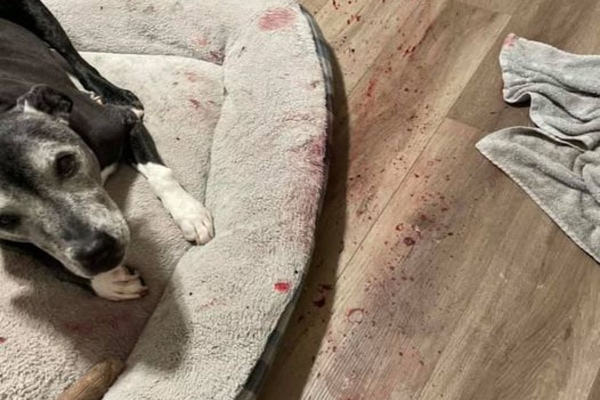
The tricky thing about nasal cancer in dogs is that the initial symptoms may be mild. For example, you might notice increased sneezing or reverse sneezing in dogs. At first, you (and your vet) might suspect that your furry friend has allergies or an upper respiratory infection.
However, these symptoms won’t go away on their own or fully resolve with allergy medicine for dogs or other treatments. And the dog might start to show other signs such as:
- Dog nose bleeds (i.e. epistaxis)—typically, the bleeding only comes from one nostril initially, but the nose bleeds may eventually involve both nostrils and increase in frequency and duration
- Nasal discharge, which may be clear, yellowish, reddish, or mucoid—usually only affects one nostril at first but may change to both nostrils as the tumor grows
- Decreased appetite
- Facial deformities (i.e. swelling, asymmetrical appearance, etc.)
- Loud or harsh breathing (almost like snoring or snorting)
- Difficulty breathing
- Being a lethargic dog
- Pawing at the face
Depending on how far the tumor invades, your dog may also have eye discharge, a bulging eye, or enlarged dog lymph nodes near the jawline. Or, if it spreads into the brain, the dog may experience blindness, abnormal gait, and dog seizure activity.
If your dog is showing any of these symptoms of nasal tumors, it is best to seek veterinary care. For dogs who are experiencing mild or non-urgent symptoms, you can make an appointment with your family veterinarian. But if your dog is having an uncontrolled nosebleed, difficulty breathing, or seizures, it may be best to make an emergency vet visit.
How is a nasal tumor diagnosed?
When you get to the vet, he or she will start by assessing your dog and gathering information from you about your dog’s history and symptoms. Then your vet will discuss the next steps with you.
Much more often than not, dogs with occasional sneezing or mild nasal discharge really do just have allergies or an upper respiratory infection. This means that initially, your vet may recommend trying symptomatic treatment.
But if the dog doesn’t improve as expected, or symptoms worsen, it may be time for additional diagnostics. Or, if the dog has more severe signs, the vet may recommend further diagnostics right away.
Unfortunately, the nasal cavity is harder to evaluate than many other areas of the dog’s body. The majority of it is enclosed in the bones of the skull. And the nasal cavity is filled with many scrolls of bone (i.e. turbinates). This can make it difficult to know what is going on inside.
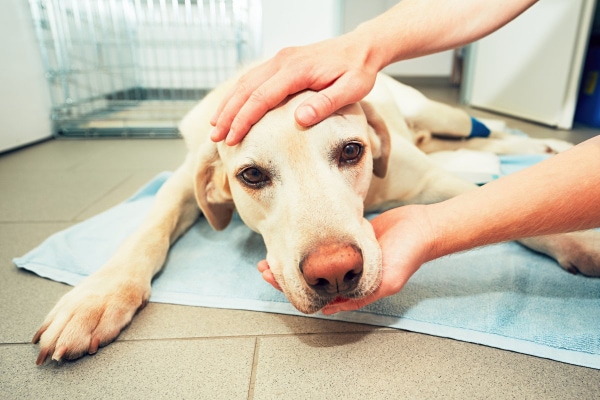
Imaging
Sometimes, X-rays of the skull and nasal cavity can help diagnose a nasal tumor. But in general, advanced imaging such as a CT scan or MRI is more likely to be diagnostic. CT and MRI are more detailed than X-rays. And they provide cross-section slices of the area of interest, which is especially helpful when looking at a complex bony structure like the nasal cavity. (The skull structures are superimposed on one another on an X-ray, which makes interpretation challenging in some cases.)
Rhinoscopy
While it may not be able to detect quite as many nasal tumors as CT or MRI, scoping the nose (i.e. rhinoscopy) is another good diagnostic option. It often allows the vet to visualize the tumor and collect biopsy samples. Plus, it may be able to rule out other nasal issues like fungal infections, foreign bodies (like foxtails in dogs), or sinusitis.
Biopsy
The best way to determine if a mass is cancer, and the type of cancer, is to perform a biopsy (i.e. collecting a sample of tissue) and histopathology (i.e. examining the tissue under the microscope).
A study of 117 dogs with nasal cancer indicated that blind biopsy (i.e. performed without being able to directly visualize the tumor), advanced imaging-guided biopsy, and rhinoscopy-guided biopsy were all equally effective at diagnosing nasal tumors. This means there are a variety of ways that the vet can collect the tissue for the biopsy, depending on your dog’s particular situation.
Additional testing
The vet may also recommend a clotting panel. This can help decrease the chances that the biopsy site would bleed uncontrollably. And it also rules out a clotting disorder as the explanation for the dog’s nose bleeds.
Additionally, your vet may suggest chest X-rays to look for metastasis (which is rare but worsens the prognosis). Or he or she may want to perform a chemistry panel, urinalysis, and complete blood count (CBC) to get an overall picture of your dog’s health.
What is the treatment for nasal tumors in dogs?
After receiving the nasal tumor diagnosis, some dog parents decide to consult with a veterinary oncologist to pursue treatment. And others prefer palliative care options (i.e. ways to keep their dog happy and comfortable for as long as possible). This is a personal decision, and there isn’t one right or wrong answer.
Radiation
Should you choose to treat your dog’s nasal cancer, the veterinary oncologist will most likely recommend radiation therapy. This involves using focused high-energy particles or waves to destroy targeted cells (in this case, cancer cells). Although there is no definitive cure for nasal tumors in dogs, radiation therapy is the best way to achieve clinical remission (i.e. the cancer goes away for a certain period of time).
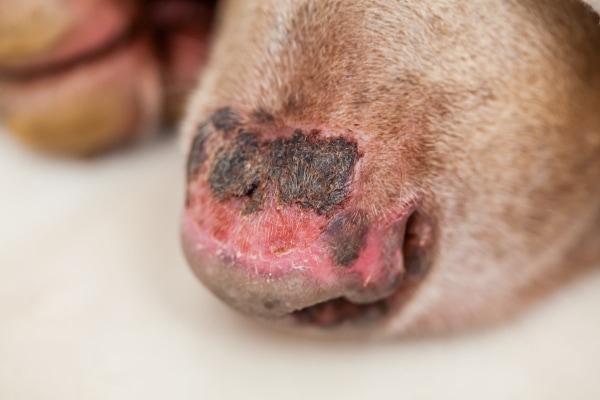
However, because of the high dose of radiation necessary for this kind of treatment, your dog may experience side effects such as:
- Redness or inflammation on the skin and in the mouth
- Peeling skin where the beam was directed (sort of like a sunburn)
- Conjunctivitis, dry eye in dogs, or even blindness due to retinal damage or the formation of cataracts in dogs
Palliative radiation
Interestingly, lower doses of radiation are also an option for palliative care. Several studies have indicated that palliative radiation can help decrease tumor symptoms.
Chemotherapy or surgery
While there are a few studies looking at chemotherapy for nasal tumors, at this point it isn’t typically the treatment of choice. Additionally, surgical debulking of the tumor may help improve some of the clinical signs, but it doesn’t improve survival time for dogs with nasal tumors. And these dogs typically still need radiation too.
Pain control
Many dogs with nasal tumors can benefit from anti-inflammatory or pain medications as well. The vet may recommend a non-steroidal anti-inflammatory drug (NSAID) like carprofen. Or he or she may prescribe a steroid like prednisone for dogs if the tumor may be affecting the brain. While not anti-inflammatory drugs, gabapentin for dogs or tramadol for dogs can also be helpful for reducing any pain associated with the nasal tumor.
Holistic treatment for nasal tumors
The herbal supplement Yunnan Baiyao for dogs seems to have an almost magical ability to stop bleeding. This means it can provide a holistic way to help prevent or manage nose bleeds in dogs with nasal tumors. Your veterinarian, or a veterinarian who is familiar with Traditional Chinese Veterinary Medicine (TCVM), can help you figure out a Yunnan Baiyao dose and frequency that is right for your dog.
Phenylephrine
Nasal phenylephrine drops may help minimize the inflamed tissues within your dog’s nose. Plus, since the medication constricts small blood vessels, it may also help with nosebleeds.
Keeping the house cool
Dogs rely on their airways to keep themselves cool, and nasal tumors reduce the efficacy of those cooling mechanisms. Therefore, leaving the temperature low in your home can reduce the risk of your dog overheating. Otherwise, without the ability to efficiently exhale warm breath, a dog can suffer heatstroke in dogs. This is a life-threatening emergency.
Also, anecdotally, many parents of dogs with nasal tumors feel that letting a fan blow cool air onto their dog’s face can make a big difference in overall comfort.
What is the life expectancy for dogs with nasal tumors?
Unfortunately, the long-term prognosis for dogs with nasal tumors is poor. Radiation therapy gives dogs the best life expectancy, with the potential of going into remission for one to two years. Additionally, palliative radiation typically decreases clinical signs in 65-86% of patients for 120 to 300 days.

Otherwise, dogs who receive no treatment may have a life expectancy of two to three months before the clinical signs become an insurmountable problem. However, untreated dogs with nose bleeds typically have a shorter life expectancy than this.
How will I know when it is time to euthanize my dog?
Because of the locally invasive nature of this cancer, and its ability to progress rapidly, I always advise dog parents to keep a close eye on their dog’s quality of life. It can be helpful to regularly fill out a quality-of-life scale for dogs. And you will want to watch closely for difficulty breathing, severe or frequent nose bleeds, blindness, seizures, or signs your dog is in pain. All of these can be indicators that it is time to prepare for your dog’s euthanasia.
I know it is never easy to face the loss of your sweet dog. And having to make that decision can weigh heavily on your mind. While I can’t tell you when it is time to let your pup go, I do want to offer several resources to help you with the journey:
- Dog Hospice Care Can Bring Peace and Dignity to Your Dog’s Final Days
- In-Home Dog Euthanasia: Heartfelt Answers to 12 FAQs
- Dog Euthanasia: Knowing When to Say Goodbye
- How Will You Know When It’s Time to Euthanize Your Dog?
- Grieving the Loss of a Dog After Euthanasia (& Finding Peace)
- Dog Memorial Ideas
Plus, your veterinarian or veterinary oncologist can help you through this trying time. Don’t be afraid to reach out and discuss your concerns or ask questions. That’s what they are there for.
Treasure the time you have
If I could leave you with a final parting bit of advice, it would be this—treasure the time you have. Unfortunately, nasal tumors don’t have a happy ending most of the time, and that can be hard to face. But you can choose to do your best to push through the sadness and find joy in the days you do have with your dog.
Spend some extra time hanging out on the couch together. Go to all of your dog’s favorite places. Make a bucket list for your dog and see how many things you can check off. Hire a photographer to capture beautiful pictures of the bond you have with your dog.
These are just some ideas to get you started. I don’t know what treasuring time looks like for you. But I do know it is worth figuring out.
Did your dog have a nasal tumor?
Please share his or her story below.


it’s just so so sad reading all of these comments about your fur babies just heartbreaking, I myself have a 11 year old frenchie, biggy,he is a rescue from a puppy farm he was used as a stud ,I got him when he was 5 when he was no longer of use,I have had him for 6 years now and I can honestly say that we needed each other, he has brought me so much joy and love ,but unfortunately he has just been diagnosed with a nasal tumour, it started of which we thought was an abcess as the vet found he had a fractured tooth and another loose one which were removed, and he was put on medication for the swelling, but it’s been 4 weeks now and there is no improvement, he has had more tests done and the vet is not keen to put him under to cut it about for a biopsy and quite frankly I can’t put him through that, his been poked and prodded non stop, he is now on palladia and steroids and is going back to the vet Monday as today I have noticed that he really isn’t his usual self ,his still eating and drinking but has an upset tummy and diarrhoea the vet said to stop the palladia for now and see how he goes until Monday, i know im facing the inevitable and it’s breaking my heart to think of life without him but I can’t see him like this, am I fighting a losing battle? do we keep trying for him to improve or is it just prolonging the inevitable, just now he brought his toy to me to play then just wanted to be picked up and cuddled which I’m doing with a lump in my throat and tears streaming down my face,I feel sick to my stomach.
Dear Lydia,
I’m so sorry to hear of this devastating news you received about Biggy. The mental picture of you snuggling him as you write this is so heartbreaking. I hope that the vet visit on Monday gives you some clear answers as to what the best path is. Palladia can unfortunately cause GI upset, as ended up being the case with Biggy. Other than the swelling, was he showing any symptoms like nose bleeds, stuffy nose, or nasal discharge? If he seems unbothered by the tumor currently, it may also be reasonable to live life to the fullest while he is feeling good and then say goodbye when he starts to decline. However, it also isn’t wrong to see if the vet can add some medications to manage the Palladia side effects or consult with oncology to find out if a different treatment might be an option. Biggy sounds like such a special dog and you are so lucky to have each other. Sending much love as you navigate these difficult decisions.
My 22 month old Golden Retriever, Arrow, apparently has it and that seems far too young. He’s been full of life, happy, and trained/just started competing in agility. They told me he cracked his 108 tooth and things went downhill from there. I kept wondering how he could have because my dogs are always with me and I don’t put them out in the yard by themselves. Anyway, after two teeth extractions, two sets of rads, a 4+ e.coli infection, four different antibiotics, and a CT scan – this is where we’ve landed. Our first meeting with the oncologist is October 13th, but it looks like there’s been quite a bit of bone damage already. They did a fine needle aspirate that was inconclusive. Arrow is eating, drinking, has normal stool, and his mouth his healed now mostly – so we’ve been taking walks and doing short fetches. It sure seems a cruel twist of fate. He’s such a good and happy boy. A real love bug also.
Dear Diane,
My heart aches for you as you face this tragic diagnosis in your young pup. I am glad he is feeling ok and has been able to enjoy his walks and play time. Hoping the oncologist will have some good ideas for treatment and a solid plan for the future. Praying for healing for Arrow and wishing you both all the best.
My now almost 13.5 year old Old English Sheepdog got diagnosed with nasal adenocarcinoma in the winter of 2025, after increasing sneezing and me discovering a bump below his eye. As he was still very well physically otherwise, we did a course of radiation, which shrunk the tumor but then recurred after about 9 months. He had several side effects from radiation in particular chronic dry nose, chronic gingiva inflammation, and bouts of sometimes severe trouble breathing (inflamed nose lining). The nasal passage on the side of the tumor pretty much remained blocked since, but he’s able to breathe quite well as long as he doesn’t have too much mucus build-up. As he was still well otherwise and tolerated the treatment well overall, we did another course of radiation last January, and although the tumor shrunk even more, he had more serious side effects with lesions on his palate. I’ve been giving him special daily care for the last year, daily tooth cleaning, disinfecting oral sprays, moisturizer for his nose, which overall kept these issues under control. The tumor has now started to swell again about a month ago. I knew that this second treatment wouldn’t give us much time, and just not being able to face a dog-less existence I decided to get a OES puppy, he’s now 7 months old and just loves his big brother. I just went to the oncologist to assess how to proceed, and the only remaining option to prevent his nostrils from closing up completely over the next few months ist to try Palladia. I’m not so sure if it’s worth it or if we should get ready to say goodbye, but then I am grateful that we’ve been able to have him with us for those additional 1.5 years and passing on some of his wonderful character to the little bundle of energy. Good luck to all of you and thanks for this informative and helpful blog! Best, Katrin
Dear Katrin,
You have been through so much with your boy over the past year. What a blessing he is still by your side and able to help teach the new puppy how to be a good member of the family. Thank you for sharing your experience and allowing us to learn a little of your boy’s story. Praying for continued comfort and peace. Bless you and yours. ♥
We just lost our sweet goldendoodle Lucy to a nasal tumor on March 25, 2026. She was only 7 years old. What initially began as what we thought was “doggie pink eye” turned out to be something far worse. Her third eye lid appeared to be swollen. I took her to the vet and was given antibiotics. It seemed to improve a bit for a few days, then started to take a turn a week into the antibiotics. She started to have a sneezing fit with a bloody spray. I took her immediately to the ER. After an X-ray they found a mass in her nasal cavity. It was a Friday night, so we could not get any additional testing done until Monday. She was comfortable all weekend on pain meds and acted mostly like her normal self. On that Monday evening, we admitted her to the hospital to be taken to internal medicine the next morning. Tuesday she had so many tests. The CT scan confirmed the tumor, which had invaded bone and was also growing towards her brain. By Tuesday, her eye was starting to bulge and become more red. Which we then knew was a result of the tumor. We discussed radiation and had an oncology appointment made for the next week. We never made it that far sadly.
The next day my girl was lethargic and started to have labored breathing. We took her back to the ER. We then had to make an impossible decision. The vet explained to us that she was in pain. The tumor was aggressive and the radiation would not be able to repair the extensive damage already done. We had to say goodbye to her that night. It was all so sudden.
Looking back there were a few signs, but nothing that would have tipped us off of something that damaging and aggressive. She had some reverse sneezing, but nothing that happened everyday. I even asked the vet and they said just to rub her throat and that made it stop. There was some regular sneezes, but again nothing that seemed alarming. I am still blaming myself that I missed something. I just wish there was more that I could have done.
Dear Heather,
My heart aches for you with your loss of Lucy. I can only imagine how difficult this must have been, especially with how quickly everything progressed. You did everything you could for Lucy, and I am certain she knew how much she was loved. Praying for comfort and healing for your heart. May her memory stay with you always and continue to be a blessing in your life. ♥
Grieving the Loss of a Dog After Euthanasia (& Finding Peace)
We are going through almost the exact thing with our 8year old goldendoodle, soooo very sorry! Its awful! Sweetest dogs ever! Sending love.
My Vader was about to turn 10 years old, lab-collie mix. He came into my life at 4 months old. I let him go 2 days ago because of his nasal tumor. His last sneezing episode at 5:00am on Friday morning of March 20, 2026… the bleeding would not and did not stop. He was still running around, looked well but the bleeding would not stop. The first sign of blood started December 1, 2025… so yes, it grew rapidly and I knew that Friday morning, I knew internally, instinctively that I could not let him bleed to death for my heart to have him for another week as my doctor, vet said he could possibly afford with a steroid and medicine to coagulate. Why? Why would I do that to him. Why was I going to wait for the continued nose bleed, the room at the vet had blood splattered everywhere, chair, wall… it was now coming out of both nostrils and I could hear it in his throat, see it on the back of his tongue… taking him home could escalate to a worse blood bath like that of Friday morning before the vets office opened because the emergency opened later. Yes, the emergency were I live works from 11:00am-11:00pm and thank God it was Friday because watching him bleed from 5:00am to 7:00am waiting for my vet to open was traumatic. I could have taken him home for a possible extra week… why?…for me. No… I couldn’t if that bleeding could not be controlled. I said goodbye. I am so hurting right now and I miss him terribly. I pray to see him again! Rest in Peace my Vader! Momma loves you!
Dear Lori,
I am so sorry for your loss of Vader. I know you would have gladly spent more time with him if you thought it was possible to stop the bleeding and ensure he was comfortable. You made a loving choice to free Vader from his struggles and offer peace instead. I hope with time the grief will begin to fade, and your heart can start the healing process. May Vader’s memory stay with you always and continue to be a blessing in your life. ♥
Our 10 year old German shepherd/Newfoundland was diagnosed early November. We had been treating what we thought was an abscess on her nose with the vet and antibiotics. Early November we heard a yelp and blood was everywhere. It kind of seemed like the lump exploded. Rushed to emergency vet where we found out the cause.
Now shes on Gabapentin, carprofen, and finishing up another round of antibiotics.
It’s so hard to figure out when to euthanize , as shes so full of energy still running around and playing (maybe even more so than before). Eating a ton and going to the bathroom fine. She does sometimes have breathing difficulty but if she moves her position changes to light snores.
We told ourselves when shes no longer running around and playing or we have to make her eat, thats when it will be the time. But our vet said her body might be fine until the end because of where it’s concentrated. So its very hard to know.
Dear Francesca,
My heart aches for you as you face this difficult situation with your senior girl. I understand your conflicted feelings about how to choose when to say goodbye. You know your pup better than anyone and I encourage you to trust your intuition. You can also find a house call hospice vet in your area to start making routine visits. They can offer suggestions for comfort care and let you know when the time has come to offer a peaceful passing. I will attach links to other articles with more information and great comments from other readers as well. Praying for clarity and strength as you navigate this emotional path. Bless you and your sweet girl.
1. Dog Hospice Care Can Bring Peace and Dignity to Your Dog’s Final Days
2. Using a Quality of Life Scale for Dogs
3. Signs A Dog is Dying of Cancer (Plus Advice for 8 Common Cancers)
4. How Will You Know When It’s Time to Euthanize Your Dog? 5 Caring, Heartfelt Messages
5. Preparing for Your Dog’s Euthanasia: 10 Thoughts for Peace