Signs of dementia in dogs can be distressing to notice. After all, we want our grey-muzzled companions to be mentally sharp and happy for as long as possible in their golden years. Integrative veterinarian Dr. Julie Buzby takes an in-depth look at the five common signs of doggie dementia and explains how to help your dog with dementia keep living the good life.
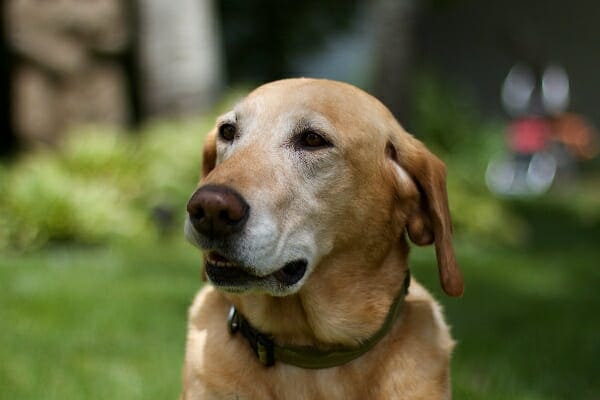
Recently, a longtime friend and client brought in his 10-year-old black Labrador Retriever, Dixie. I had known her since she was about three months old. Dixie pranced into the vet clinic with the same happy attitude that she is known for.
However, Dixie’s dad looked very concerned. As I asked what was going on, my client started describing some changes he had noticed at home recently. His dear Labrador Retriever was no longer sleeping through the night. She was also barking more than normal and had started to show some aggression towards her “brother,” a small Terrier mix. It was very obvious that something was changing with his beloved dog.
Finally, he looked up at me and said, “My dog is doing things I never would have expected from her. Can dogs become senile?” I looked back at him and told him, “Yes, unfortunately, dogs can develop dementia.”
I went on to explain to my client that our canine companions are living longer than they used to because of the wonderful care they receive at home and from their veterinarian. This is great news because it means we get more time with our dogs. However, it also means that an increasing number of dogs are living long enough to develop dog dementia—also called Canine Cognitive Dysfunction in Dogs (CCD) or Cognitive Dysfunction Syndrome (CDS).
What is dementia in dogs?
Dementia occurs in senior dogs as they age. Their brain undergoes changes that are very similar to what doctors see in human Alzheimer’s disease or dementia patients. In fact, a 2019 article published in Frontiers in Neuroscience compared canine cognitive dysfunction and Alzheimer’s disease in detail. These brain changes can affect a dog’s memory, behavior, sleep patterns, activity, and appetite.
In recent studies, it has been estimated that approximately 28% of senior dogs develop CCD by 11 to 12 years old. When dogs reach the ages of 15 to 16 years, it is estimated that approximately 68% have doggie dementia.
What are the signs of dementia in dogs?
The first signs of canine dementia may be difficult for you to recognize. Early signs of cognitive decline are sometimes very subtle. That’s why it is important that dog parents know what to look for.
Dog dementia symptoms are grouped into three stages—mild, moderate, and severe. There are typical patterns that appear within each stage. However, it’s important to note that not every dog follows these exact patterns or stages.
So any of the signs described below could be seen at any time once dementia sets in.
3 stages of dog dementia
Stage one: Mild
In the early stage of dementia in dogs, signs tend to be more mild and easier to miss. You may notice changes in your dog’s sleep patterns and maybe mild changes in how your senior dog socializes with you or other pets.
Stage two: Moderate
The moderate stage is when signs may become more apparent to you. The most frequent sign of dog dementia at this stage is house soiling—even though your dog was previously house-trained.
Stage three: Severe
The last stage is severe symptoms. In this stage, the signs mentioned above tend to increase. Also, you may notice your dog starting to wander around the house throughout the night instead of sleeping. Your dog may begin to bark more at things that aren’t really there.
5 signs of dementia in dogs
Let’s explore the five signs of dog dementia in depth.
1. Disorientation
Some dogs with dementia seem to lose their sense of direction or may walk around appearing confused. Disorientation can be seen in a variety of ways in our senior dogs. Some dogs may walk up to furniture and appear unsure of how to go around it.
If you have ever seen the movie A Bug’s Life, the scene at the very beginning of the movie when the leaf falls and blocks the line of ants carrying food is similar to disorientation. That leaf falling blocks the path that the ants always take, and they become disoriented and need the other ants to lead them around the leaf back to the correct path.
Sometimes, as our senior dogs become disoriented, they might need help just like this to re-learn how to go around the couch or table to get where they want to go.
As our beloved companions age, they may also experience vision changes or cloudy eyes in dogs. Impaired vision can combine with mild dog senility to create more significant confusion and disorientation.
Other signs of disorientation include:
- Forgetting where the water bowl or doggy door are located even though they have always been in the same spot.
- Walking in circles as if stuck in that motion and don’t know how to stop.
- Getting stuck in a corner or standing with the head leaning on the wall like he or she doesn’t know what to do (head pressing).
- Standing at the wrong side of the door when it is opened.
If you begin to see your dog exhibiting any of these signs, but you are not sure if your dog is truly disoriented, take a video to show your vet. This will help you explain what you are seeing so your vet can figure out the best way to help your pup.

2. Changes in social behavior
One of the most common reasons dog parents bring their dog to the vet is social behavior changes at home. These changes may occur with the people living in the house or with other pets. As mentioned, doggie dementia affects our dogs’ memories. This means they may forget those that they live with or forget how they normally play with other dogs or cats.
Some dogs become less interested in playing with or receiving attention from their people. This may mean they no longer care when company comes over. They used to get excited or bark to greet guests, but now they don’t. Other dogs may become more needy and want extra attention.
Finally, the change that is usually the most concerning to owners, is sudden aggression toward people or animals. This was one of the big problems my client was seeing because Dixie was attacking her terrier “brother.”
If you begin to see changes in behavior at home, especially more aggressive behavior, please discuss it with your veterinarian immediately. While these changes may be related to dementia in dogs, it is important to make sure that there are no other health problems going on.
Arthritis in dogs or other causes of pain in dogs could also cause your senior dog to act differently. A painful dog is often more likely to growl or snap when painful parts (such as hips or back) are touched.
3. Changes in sleep patterns
In some cases, altered sleep patterns may be the first sign that you recognize in your furry friend because this interrupts your own sleep. Dogs with dementia often start waking up more in the middle of the night than they previously did. Dementia can be one of many causes of senior dog anxiety at night.

Your dog may do different things when he or she wakes up. Some may pace back and forth all night as if they are anxious about something. Other dogs may wake up barking as if someone knocked on the door or they saw a ghost. And others may wake up and decide they are starving and need to eat right then!
Some dog parents describe this stage as being similar to having a newborn baby at home. Or others may compare it to sundowning in humans with Alzheimer’s (which is why CCD is sometimes called sundowners in dogs). It is okay to be frustrated when this happens because it is exhausting for both you and your dog!
4. Accidents in the house
As canine cognitive dysfunction progresses, some senior dogs may forget the commands and tricks you previously taught them. When you say “sit,” “come,” or “stay” they may just look puzzled. Senile dogs may also forget all that hard work you put into house training. Inappropriate urination or defecation in the house may occur due to:
- Increased anxiety that occurs with dementia.
- Going outside and forgetting what they were supposed to be doing.
- Forgetting where the doggy door is or how to use it.
- Forgetting their body cues and not realizing they have to go until it’s an emergency or too late.
- Forgetting how to signal to you that they need to go out.
However, accidents in the house can happen for other reasons in senior dogs. Urinary incontinence in older dogs, Cushing’s disease in dogs, diabetes in dogs, administration of medications like prednisone for dogs, or urinary tract infections in dogs may also cause urinary accidents. It is important to discuss accidents and other signs with your veterinarian to ensure he or she has the needed information to make the right diagnostic and treatment plan.
5. Increased anxiety and changes in activity or appetite
As mentioned, doggie dementia may cause increases or decreases in activity. Increased activity usually presents as pacing or restless nights. On the other hand, dog parents may easily mistake decreased activity during the day for age-related slowing down. Dementia patients commonly want to sleep more during the day (more than the number of hours an old dog should sleep) or may not be as excited to play as they used to be.

Activity may also change because anxiety can become worse once dementia sets in. Sometimes, dogs can sense the changes happening. They are scared and confused because they don’t remember how to follow commands or they keep getting lost around the house.
In addition to confusion-based anxiety, some senior dogs with dementia may develop noise-based anxiety. This may include reacting to fireworks, thunder, or even small noises like car alarms or the stove beeping. Another common sign some owners notice is that their four-legged friend is more attached to them. This can be a result of separation anxiety.
Since activity can decrease and anxiety can increase, another sign is decreased eating and drinking. If your old dog is not eating well, CCD may be the cause. This may occur because dogs feel too tired or confused to get up and go to the bowl. Also, they could forget where the bowl is located or forget that they were hungry or thirsty.
How is doggie dementia diagnosed?
The most important diagnostic step is for dog parents to notice the signs at home. You spend the most time with your furry friend and you know him or her best. Dogs often tend to behave differently at the vet than they do at home, so your vet may not be able to see what you see.
It is important that you let your veterinarian know when your dog’s behavior is changing and you think something is wrong. If you are confused about what your senior dog is doing or don’t know how to describe it, pull out your smartphone. Pictures and videos can help your vet “see” what is happening.
Additionally, you could consider filling out a canine cognitive dysfunction checklist and bringing it to the vet appointment. This sort of tool can provide an overview of the symptoms your dog is exhibiting, which also helps with the diagnostic process.
Once you bring your dog to the vet, he or she will ask you to describe what is going on. Typically, your vet will also ask a variety of follow-up questions. Sometimes he or she may recommend different tests such as blood tests for dogs, X-rays, ultrasound, CT, or MRI. These tests can help rule out other health issues that could have similar signs.
These steps are important because there isn’t an easy “yes” or “no” test that can definitively say if your dog has dementia. Ultimately, your vet makes the diagnosis based on your observations after ruling out other conditions.

How are signs of dementia in dogs treated?
Unfortunately, there is no cure for doggy dementia. But we can treat some of the symptoms to improve quality of life. Your veterinarian may prescribe medications or supplements to help keep your dog comfortable and manage anxiety or disrupted sleep patterns.
Some of the more common may include:
- Melatonin for dogs, which may help restore normal sleep-wake cycles—As a word of caution, some formulations of melatonin, especially melatonin gummies, may contain the sugar substitute xylitol, which is toxic for dogs. Always check the label for xylitol (sometimes called birch sugar) before giving melatonin supplements to your dog.
- Anti-anxiety medications such as trazodone for dogs
- Anipryl® (Selegiline for dogs), a medication that affects signaling chemicals in the brain to manage the signs of dementia
- Omega-3 fatty acids for dogs
- S-adenosylmethionine (SAMe)
- Medium chain triglycerides (MCT oil for dogs), which provide easy-to-use energy for the dog’s brain and may help support and improve cognitive function in dogs with CCD. A great source of high quality MCT oil formulated for dogs is Dr. Buzby’s Brain Boost™ organic MCT oil for dogs.

There are a variety of medications, supplements, and diets that may help with dog dementia beyond the short list shown above. Your vet is the best person to decide which of these options are right for your dog, which is why they are not covered in more detail here.
Please keep in mind that senior dog supplements are not regulated by the FDA and some are more effective than others. I always advise talking to your veterinarian before beginning any OTC supplements for your dog.
Things you can do at home to help your dog’s memory
There are also activities you can do at home to help your dog’s memory. You may have heard human doctors recommend puzzles to Alzheimer’s patients. Puzzles can be good for dogs too! You can try different “thinking games” at home such as food puzzles (found online and at most pet stores).
Some owners play “watch the food” where they put a piece of food under a cup and leave two cups empty. Then they move the cups in a circle on the floor and the dog has to find the food. This is a great way to keep your senior dog mentally stimulated, and can also be a way to encourage them to eat.
For dogs with severe dementia symptoms, a consultation with a veterinary behaviorist may be helpful to develop strategies to help keep them comfortable and calm.
Back to my client, the lovable Labrador with dog dementia
Dixie’s relationships with her dad and “fur sibling” improved after starting anxiety medication and learning “thinking games.” She loves to play hide-and-seek with her dad. He told me that once he taught her this game, their relationship grew back to where it was and her activity level seemed to improve.
She still has some hard days, but she continues to love food and going on her walks. Her dad understands that just like with human Alzheimer’s or dementia, it can progress over time. And he knows that eventually he will have to face that dreaded decision of when to euthanize a dog with dementia. However, he is making the most of her golden years and plays an important role in helping her improve!
Hope for dogs who are showing signs of dementia
If your senior dog is showing some signs of dementia in dogs or if he or she has recently been diagnosed with CCD, it can be normal to feel scared or unsure of what is next. However, there are so many ways you can improve your dog’s quality of life.
Dementia doesn’t have to define the last chapters of your dog’s life. Be sure to ask your veterinarian any questions that you have and work with him or her to develop a plan for your dog. Together, you can help your senior dog have comfortable, happy golden years in spite of his or her doggie dementia diagnosis!

Does your dog have dementia?
Please comment below to share his or her story.


My 14 yr. old pug has started to go under my bed and bark hysterically, comes from under bed exhausted. grts startled easily, confused but has a good appetite. follow me around the house, has jow acquired separati9n. I believe he has dementia
Hi Bonita,
I agree, it does sounds like your Pug may have some symptoms of dementia. This would be a good thing to discuss with your vet. There may be a supplement or medication that could greatly improve your dog’s quality of life.
We have a 15 year old Jack Russell mix, Bacon, who is the love of our lives. We adopted him at approx. 8 mos old. This past year has been a slow and steady decline, and thanks to sites like this one we’ve determined that he also has CCD. He’s been walking into walls, getting confused, stuck under chairs, doesn’t know the correct side of the door, paces constantly, is up all night and sleeps most of the day, has accidents in the house, he can’t be picked up and doesn’t come when called. He could be blind and deaf, but most symptoms point to CCD. The hardest part is that he doesn’t appear in distress but has stopped doing all the things he loves (jumping on the couch, cuddling, sleeping in our bed, going for walks). He cannot find comfort on a blanket or in a dog bed and ultimately falls asleep where he lands.
We have made the decision to say goodbye and have come to terms with it. We know it will be one of the hardest things we will do as a family, but ultimately it is the best decision for Bacon.
These posts are so supportive and helpful – thank you to everyone who has posted!
Dear Karla,
My heart goes out to you as you face this emotional decision for Bacon. I know his presence in your lives will be dearly missed but glad he will gain peace from his struggles. Thank you for sharing your story with us. I am sure this will be the comfort someone else needs to navigate an uncertain road. I pray Bacon’s passing will be smooth and may his memory be a blessing. Bless you all.
Hi, I have a Jack cross, little girl called Bramble, she is showing very similar signs as your Bacon but just not so advanced. She is sleeping closely to me in bed, which is wonderful, eats well; but stands at the wrong side of the door, has peed and done poos inside, and on my bed once. She is completely silent, not a single peep, deaf and blind. She seems happy enough, still loves her walks and food. I’m sending you lots of love.. I am dreading the day, it’s been me, my daughter and Bramble for nearly 16 years.. God bless our most special friends.
I have a 11 year old beagle boxer Sammi noticed more dribbling and she would go to sleep and then urninates so she was p[aced on Estradiol 1 mg now taking 1 tablet every 5 days . So on Saturday I took her to the vet because her anxiety has been through the roof for the last 3 days and very clingy then normal I tried over the counter calm tablets they did not help so the vet put Sammi on Fluoxetine 40 mg 1 tablet daily did blood work her organs are fine and talked alittle about demita said to check back in 2 weeks. Today she did drink some water but would not eat any treats or food or going out side can be a challange but once she is outside she is fine but still having anxiety issues . Wondering if I should have the vet prescribe Anipryl also.
Hi Amy,
I understand your concern for Sammi and her anxiety struggles. Sometimes it can take some trial and error to find the best combination of medications for dogs with dementia. I do think it would be a good idea to talk to your vet about what options are still available to try. I am not sure if Anipryl can be combined with all the other treatments Sammi is currently receiving, but your vet will know what is best for her specific situation. I hope you can find the magic combination for sweet Sammi. Best wishes to you both!
My situation is similar to Robin and Kathleen’s above. I have a 13 year old Shiloh Shepherd with dementia, arthritis, and hip dysplasia. He’s on Metacam, Gabapentin, and I’ve even tried CBD oil for him but that last one doesn’t seem to have helped. Despite the medication, the anxiety is causing a lot of stress and sleeplessness. I work from home and he’ll whine, pace, pant, and nudge me for 4-hours at a time most days. It makes work challenging and the same will frequently happen at night. Just this evening he went into a panic attack on our walk and I have no idea why. I think the time has come and I just needed some reassurance that doing it for mental health was alright.
Dear Carolyn,
I understand your concerns with your senior boy and his struggles with dementia. Yes, it is ok to consider euthanasia for mental health decline in your Shepherd. I definitely feel like the suffering that comes from cognitive dysfunction can be just as bad, if not worse, than what is experienced with physical problems. Choosing to give your boy peace and rest is the most loving and unselfish decision you can make. But don’t forget that your quality of life matters too. Here is a link to another article with more information and great comments from other readers: Dementia in Dogs: When to Euthanize Your Beloved Senior Dog
I hope you can find the answers you need to gain peace and clarity with your difficult decision. Give your sweet boy a hug for me and bless you both. ♥
My baby boy Blitz age 13 is experiencing so many of the conditions you describe. He has loss of appetite barks at nothing and seems confused . The worst is the barking , pacing, panting at night. It went on for 3 hours and the medication are
not working I agonize over the thought of putting him down but I know I cannot maintain this lack of sleep. He still loves to be outside and sleep in his “ sun spot”. I am crying as I write this
Dear Mary,
My heart goes out to you and this difficult situation you are in with Blitz. I hear the concern in your words and can only imagine how drained you must be after dealing with this nighttime anxiety. Please know that “letting go” is ok and not a bad choice for your sweet boy. It is hard to really evaluate quality of life when most of the issues are mental instead of physical. But I do think that the mental struggles can cause as much suffering as physical issues, if not more. Also, your quality of life matters too. ♥ Here is a link to another article that may offer additional advice and great comments from other readers: Dementia in Dogs: When to Euthanize Your Beloved Senior Dog
I hope you can find the information you need to make the best decision for you and Blitz. Praying for strength and clarity for you and peace and rest for your senior guy.
My 11 yr old Sheltie has many of the same actions as everyone describes. What has worked wonders for her is melatonin in the morning to help her nap during the day instead of pacing…then mela tonin again one hour before bedtime. She also takes, prescribed by vet, alazopran at night. She takes one Sam-E 1 hr before dinner. This has all made a tremendous difference. The vet guided us every step alongbthis very difficult journey. I went without sleep for weeks and finally addressed the situation with the vet. When i told her of the confusion, forgetfulness, attitude changes, she knew just what to do. Blessings to everyone going thru this. It is rough.
Hi Michele,
Thank you for sharing your experience with our readers. These are great suggestions of things for others to discuss with their vet. I am glad you have found what works for your Sheltie and that it has improved her quality of life. Best wishes to you both for many happy days ahead!
We are struggling with our 15 y o labradoodle, Lucy. Her at least year + of obvious dementia includes reversed sleep cycle, whining at night, rapid pacing, loud barking for no reason. She is also almost completely blind, so she walks into things anyway, but now there is no caution and she runs into things at full speed. She started urinating in the house several times a day as if she is outside. She eats ok and drinks ok and can still get up (even with her 2 knee replacements). She still enjoys short walks and enjoy all the smells. We are losing our minds with little sleep for the past year. We love her like crazy. We have tried melatonin, CDB, trazodone and gabapentin. While she is miserable at night, but she is relatively ok during the day. When is the “right” time to say gooddbye?
Dear Robin,
It sounds like you have done everything you can to try and keep Lucy comfortable and safe. At some point, despite our best efforts, saying goodbye is the most loving and unselfish decision we can make. You have to take into consideration your quality of life and if the stress of being a caregiver is breaking the bond with your sweet girl. I will attach links to other articles that may offer additional information and advice. Many of the articles also have great comments left by other readers. I hope you can find the answers you need to make the best decision for you and Lucy. Praying you find clarity and comfort for the days ahead.
1. Dementia in Dogs: When to Euthanize Your Beloved Senior Dog
2. Preparing for Your Dog’s Euthanasia: 10 Thoughts for Peace
3. In-Home Dog Euthanasia: Heartfelt Answers to 12 FAQs
4. Dog Euthanasia: Knowing When to Say Goodbye
5. How Will You Know When It’s Time to Euthanize Your Dog? 5 Caring, Heartfelt Messages
Hi, I am in the same place now, as Robin, (the above email). My sweet black lab is almost 14. She has dementia and I believe GOLPP. She has had back legs shaking for awhile and now they are giving out at times. Also heavy breathing and panting. Her dementia has gotten really bad, as far as the night -time pacing and panting. She was up for hours last night pacing back and forth and panting heavily. I gave her trazadone and then gabapentin, tried consoling her, but nothing was working. Finally gave her xnax. I am so wiped out! I have been up many times in the past few weeks and getting little sleep. I am having such a hard time making the decision to put her down. During the day she is better, but sleeps a lot. Thank you for the articles you posted and any other advice. I am struggling!
Hi Kathleen,
I understand the heartache and grief that comes with making a decision to say goodbye. It does sound like your girl is struggling and her quality of life is suffering. I am worried about you and your lack of sleep. ♥ I am glad you read my comment to Robin as it does sound like everything applies to your situation as well. Praying you find the strength to give your sweet girl peace and rest. May your heart be comforted knowing you did everything you could. I have no doubt your Lab girl knows how much she is loved. Bless you both.
I hope you’re doing ok. It’s been a couple of days since your post here and you may not have gotten the reassurance you needed. I always heard, and thought, I’d know when the time was right. And the time came. And I agonised over it with QoL questionnaires and chats to friends. I felt the decision was right… and worried for a long time afterwards I was wrong. I now think if you bring compassion and understanding for the dog’s plight to the process, as well as some logic, take the vet advice and also apply the prognosis… it’s all you can do. And there is hardly ever a right time if it’s not from a trauma. I’m sorry. I hope you’re coping. My heart sits with you while our doggos sit on the rainbow bridge watching us together. ?
My 13 year old
Multi-pug Dulce first showed signs of dementia about 6 months ago. She has declined very quickly since then. It started with soiling in the house and has progressed to walking into walls , losing her way in and outside, forgetting what she was doing and standing on the wrong side of doors. She also leans her head and face against walls and stares into space. She has forgotten her name and she not come when called any longer. This morning she had forgotten how to drink from her water bowl. She kept stepping in it. I was able to get her focused enough to drink. Coupled with her difficulties in moving about and her unsteady gait and near blindness I have made the very difficult decision to put her down. Our vet is coming to the house tomorrow. I am really struggling and I feel terribly guilty and can’t help but asking myself if I am moving too quickly. Her quality of life is not great, she spends the day sleeping on her bed in a play pen of sorts lined with pee pads because she has also forgotten her potty training. I hope that I am able to come to peace with my decision. She was a rescue but she saved my life as much as I saved hers. She gave me the companionship and the fulfilling sense of caring for someone that I greatly needed while going through a very painful divorce. I have had her 5 years after adopting her at 8. I will miss her so very much and my house will not be the same without her. Please give me some reassurance. People have told me when it’s time I will know it. My mind knows it but my heart doesn’t. Thanks for article.
Dear Andrew,
I understand your heartache over saying goodbye to your beloved Dulce. No matter how well our brain knows it’s time, our heart is never ready. It sounds like you made the right choice and that it came from a place of love. What a blessing to be able to give your sweet girl the peace and rest she deserved. I pray as time goes by your heart will heal. May her memory be a blessing and offer you comfort as you continue along the journey of life.
Andrew
I’m so sorry for your loss. Your beautiful baby knew she was so loved by you . Hope you are okay . My heart goes out to you ❤️
I have 2 Westies, brothers from the same litter, both 14 and a half now.
Mousie Helion, as in hell on earth, (he’s a sweetheart really) has stage 3 to stage 4 kidney disease so is on a very restrictive diet. He collapsed out of the blue about a year ago and nearly died. Fortunately he had great care very quickly and is doing remarkably well now. He takes Telmisartan daily to prevent protein build up and a phosphate binder with all his meals. His bloods are getting better but now he’s losing appetite so he’s also taking mirtazapine to increase his appetite, half the time I have to feed him by hand and I wake up not knowing if I’m going to be able to get him to eat any food before I head to work. It’s stressful looking after 1 older dog, but 2 is killing me.
The other, Wolfie Mayhem, yup as in.. well Mayhem (he’s also a sweetheart really) has had 2 TPLO surgeries so it’s easy to think the weakness in his hind legs could be due to having had surgery on both and also being due to his general age but it’s more likely however to be due to the fact he has Sick Sinus and signs of congestive heart disease. His body isn’t telling his heart to beat properly and it’s likely his body isn’t getting enough oxygen so he’s now on Theophylline twice daily. Prior to that medication he used to collapse a lot, he had these choking/fainting fits. He coughs fairly frequently still but I’m not sure that’s the heart though, I think it’s more likely his collapsed trachea as it is brought on if you touch his throat.
He was showing some discomfort at nights but we’re limited on the meds he can have as he has very early stage kidney disease also (he’s also on a restrictive diet). He tried a few things including gabapentin which just wiped him out even at really low doses. Now they’re pretty sure he’s got dementia, he walks around at night, stares aimlessly at the walls or the inside of his cage, he’s always hungry, I think he forgets he has eaten. He gets stuck in places he never used to go in the flat, most recently under the recliner with his head just resting on the mechanism underneath, then he starts whimpering and he has to be rescued. he’s starting to have the usual accidents in the house, he’s good with training pads but frequently he will use them then go into the lounge and go a second time in the middle of the room. it’s hard because I can’t tell him off, he won’t understand, but I also can’t successfully retrain him the right thing to do. The thing is he becomes more lively if he’s out of the house and off the lead, he has to be off the lead though, he just won’t go to the toilet outside anymore, it’s almost as if he has forgotten why we have gone outside. I used to use key words, if I said ‘Hurry Up’ outside they would go to the toilet but he’s forgotten that now.
He’s about to start Selgian for the dementia, I’ve no idea how effective it is but the drug they wanted to give him can’t be used because of his albeit early stage kidney disease. This takes longer to kick in so I guess it’s a waiting game.
I just looked over at him, he was trying to get in to his cage, it’s a large cage with pillows, we got it after TPLO surgery a few years back and they both love it but not at the same time. Anyway, if Mousie is lying besides his brother in the cage when I get home I know Wolfie hasn’t had the greatest day. They both find it hard climbing on my bed where they used to sleep, so I’m forever picking them up when they try to get up and have to react at a moments notice when they want to get down again, not easy as I’ve just had shoulder surgery myself. Anyway, I just looked over and he couldn’t even get in his cage because there is a little lip he needs to walk over in the door way, only about 3 inches high, yet he keeps tripping over it.
My last Westie had Cancer of the throat, we had to let him go aged 12 and a half. The thing is until the end we didn’t really use his insurance, so this time I took a gamble.
These guys have always had everything they want and need and always will but I swear they’re going to bankrupt me, but they’re my babies and that’s what you do for your babies.
Whilst they’re comfortable, happy and appear to be enjoying life they’re going nowhere. I’m not stupid, I know what the future is likely to hold, quite possibly within the next year, but I’m not letting them go just because it’s difficult for me to look after them, likewise I understand that I can’t keep them around forever just to make me feel better. It needs to be what’s best for them, always.
The best advice I would give anyone would be to get that insurance that I gambled I wouldn’t need. You may not need it, but there’s a very good chance you will and unless you’re willing to cover everything out of your own pocket in the middle of a cost of living crisis you need to do what’s right for your babies. Otherwise go get yourself a goldfish.
Anyway, If anyone has had experience with Selgian for dogs I’d love to know how it went. Anything for a little peace of mind would be appreciated right now. Alternatively if anyone has any suggestions for dogs with dementia it would be appreciated, bearing in mind that kidney disease will restrict many of the things he can take.
Any advice appreciated.
Hi Simon,
It is very clear that both of your pups are dearly loved, and they are lucky to have you advocating for their happiness and well-being. Thank you for sharing your experience and your advice on pet insurance is spot on. Here is a link to another article that discusses the use of Selegiline for dementia/cognitive dysfunction in dogs: Selegiline for Dogs: A Helpful Medication for Canine Cognitive Dysfunction
I hope that you will find the advice you need either in the article itself or in the comments left by other readers. Wishing you all the best as you continue to navigate this difficult path. Bless you and your sweet boys!
In 2017 we said goodbye to our 17 1/2 yr. old Chihuahua. He had a healthy appetite, but, unfortunately, his CCD affected every other facet of his life. He forgot how to go on a walk, why he went out the doggie door, would circle endlessly and lean on the wall, get caught between the door and the wall, go under a chair and not know how to back out and on and on. We had built him a ramp with lights to get in our bed because his vision was greatly declined. He eventually forgot how to go up the ramp, but could go down it. He would run panicked back and forth in the yard once he did go through the dog door. He was urinating all the time in the house, but we just kept two mops ready for it as we knew he couldn’t help it. It got to where he couldn’t sleep through the night once he got in bed. He would suddenly lay down and sleep for about 10 minutes and then jump up scared and trying to get down. Melatonin did not help. I was so afraid he would jump off the bed, so I had to remove the ramp so he wouldn’t try to go up. When it became a matter of his safety because we couldn’t kennel him (I don’t believe in doing that to an animal) and I couldn’t sleep for worrying about him getting stuck somewhere, I knew it was time to give him his wings. No supplements were suggested by his vet. I wish we had tried some. We now have a 15 1/2 yr. old Yorkie who has just started showing cognitive decline. I have been giving him a senior multivitamin and Dasuquin, but don’t know how good the quality is on those. Would love to have some recommendations.
Hi Kay,
So sorry for the loss of your Chihuahua and the struggles of those last few months. It sounds like you guys did a wonderful job of loving and supporting him through his CCD. Thanks for sharing his story with us. As far as your Yorkie, I think it is great that you want to figure the best ways to keep his brain as sharp as possible. Without being able to examine your dog and know his medical history, I can’t safely make any specific recommendations for him. However, there are a vast array of foods, supplements, and even some medications that may make a difference. I list some of those in my article Senior Dog Anxiety at Night? 6 Solutions for Better Sleep. It would be worth asking your vet if he or she thinks your dog could benefit from any of them (and I always recommend consulting your vet before you try any supplements or meds). Playing brain games, like they did for Dixie in the article, can also make a huge difference. It is also possible that there is a vet in your area who has a special interest in caring for dogs with CCD. If so, you could consider a consultation with him or her as well. Best of luck! ❤
Hello Dr. Buzby,
First of all I just want to thank you for all the articles, resources and advice you provide to us all, it is very much appreciated and so helpful!
We are struggling with knowing if it’s time to say goodbye to our last furbaby. We have an almost 15 year old shipoo named Bentley who is diabetic, deaf, blind, has dementia, has anxiety, has a bad back, hacks/coughs frequently usually at night, has adenomas all over and keeps getting more and more of them – she scratches/chews at them because they’re itchy/irritating, digs, can’t seem to get comfortable a lot of the time, stares into space, forgets why she’s outside in the first place, wanders, sleeps probably close to 15-20 hours a day, whines for no apparent reason- doesn’t seem like it is from pain but unsure as she does have some arthritis, doesn’t eat well and has consistently lost weight the last few years. Also, sometimes she just seems to not be herself, almost as if she has checked out/changed.
On the other side of things she still gets excited to go for walks or to see her Grandparents, sometimes will still want to jump up on our laps and be pet, likes treats. She doesn’t have any accidents in the house and has only gotten stuck/confused in certain spots a few times.
I’m sure there is more I could tell you but the main thing we are struggling with is knowing when it’s time to say goodbye. We don’t want to be selfish and just keep her here because we can’t bare to let go, especially when she might be suffering. We are also quite exhausted as we have been at this for a while (she has been diabetic for going on 6 years now, her dementia symptoms started a few years ago, as well as the other things/symptoms she has). But we feel bad/selfish for even thinking about that side of things either.
It is hard to imagine life without her and every time we think or talk about making this decision it tears us both apart. We know it will eventually happen, but how do you know when?
Any help or advice you could provide would be greatly appreciated.
Thank you so much,
Ashley
Dear Ashley,
My heart goes out to you as you face this difficult decision for Bentley. I understand how hard it is to think about letting go, but in your heart, I think you already know it’s time. Your list of her daily struggles and issues is quite extensive. Just because she still enjoys being around her family and isn’t having accidents in the house doesn’t mean her quality of life is good. I would rather let go one day too early than one day too late and allow unnecessary suffering. Only you can choose to offer your sweet girl peace and rest. I will attach links to other articles with more information on how to make this emotional decision. Praying for clarity and comfort for your heart.
1. Using a Quality of Life Scale for Dogs
2. Dementia in Dogs: When to Euthanize Your Beloved Senior Dog
3. When Caring For A Sick Pet Becomes Too Much: Pet Caregiver Fatigue
4. How Will You Know When It’s Time to Euthanize Your Dog? 5 Caring, Heartfelt Messages