Is your middle-aged or senior dog drinking and urinating more than usual? Does your dog have a pot-bellied appearance? These are just a few signs of Cushing’s disease in dogs (also known as hyperadrenocorticism). Integrative veterinarian Dr. Julie Buzby shares symptoms, diagnosis, medications, prognosis, and life-expectancy for Cushing’s disease in dogs.

“Have you ever heard of Cushing’s disease in dogs?” I asked my new veterinary client, the loving parent of a 15-year-old Labrador Retriever, Jake. I knew it was important that we discuss Cushing’s disease at that appointment because Jake’s symptoms were textbook for the condition.
My client had mentioned noticing Jake’s thirst, urination, and panting were increased. These are three cardinal symptoms of Cushing’s disease in dogs. Also, while we were talking, I sat rubbing the thin skin of Jake’s pot belly. (Yes, thin skin and a pot belly are two more cardinal symptoms.)
By the end of our conversation, my client had a good idea of what Cushing’s disease was, tests for Cushing’s, and what the diagnosis could mean for his dog. And I hope you come away from this article on Cushing’s disease with a better understanding of the condition, too.
What is Cushing’s disease in dogs?
Cushing’s disease in dogs (i.e. hyperadrenocorticism) occurs when an older dog’s adrenal glands produce too much cortisol, a stress hormone. Cortisol is the body’s natural steroid and is absolutely essential for day-to-day life. Normally, the body regulates cortisol levels very carefully. But if the amount of cortisol gets out of whack, as occurs in Cushing’s syndrome in dogs, bad things can happen!
What causes Cushing’s disease?
This increase in cortisol levels can occur for three main reasons—a pituitary tumor, an adrenal tumor, or the administration of steroids. Let’s take a look at each of these three types of Cushing’s disease in dogs.
Pituitary-dependent Cushing’s disease in dogs
Approximately 80% of dogs with Cushing’s disease will have pituitary-dependent Cushing’s disease. This type occurs when the dog develops a tumor in the pituitary gland. The pituitary gland is a tiny structure located at the base of the brain that controls the secretion of various hormones.
One of the many hormones that comes from the pituitary gland is adrenocorticotropic hormone (ACTH). This particular hormone, ACTH, is what tells the adrenal glands (paired bean-shaped glands located near the kidneys) to produce cortisol. When a pituitary tumor releases more ACTH than normal, the adrenal glands obediently make more cortisol. And the end result is pituitary-dependent Cushing’s disease.
Do not fear, though! While the phrase “brain tumor” is frightening when used in the same sentence with our beloved dogs, these tumors are usually small and do not spread. Only occasionally does a dog have a larger tumor.
Overall, smaller breed dogs (e.g. Bichon Frises, Miniature Schnauzers, Yorkshire Terriers, Lhasa Apsos, or Jack Russell Terriers) are more likely to have pituitary-dependent Cushing’s disease. And they tend to be middle-aged or older (at least 7 years of age).

Adrenal-dependent Cushing’s disease
In the other 20% of dogs, a cortisol-secreting tumor grows on the adrenal gland instead. This tumor can be benign or malignant (i.e. cancerous). Since the adrenal glands make cortisol, functional adrenal tumors also lead to elevated levels of cortisol in the body. The official name for this form of Cushing’s disease is adrenal-dependent Cushing’s disease.
Unlike pituitary-dependent Cushing’s, adrenal-dependent Cushing’s is more common in medium or large breed dogs. And the average age at the time of diagnosis is 11 years.
Iatrogenic Cushing’s disease
While the pituitary-dependent and adrenal-dependent forms of Cushing’s disease are the two naturally-occurring varieties, there is also a third reason dogs can have Cushing’s disease—iatrogenic Cushing’s disease. The term “iatrogenic” indicates that a medical treatment or procedure accidentally caused the condition.
In the case of iatrogenic Cushing’s disease, the administration of prednisone for dogs or other corticosteroids causes the Cushing’s disease. These drugs mimic the action of cortisol in the body, so they can cause identical symptoms to adrenal or pituitary tumors. However, this is not to say that every dog who takes steroids will develop iatrogenic Cushing’s disease.
What are the symptoms of Cushing’s disease in dogs?
If you have ever taken a steroid (for example, prednisone) for a medical condition, or your dog has been on steroids in the past, you may have some idea of the symptoms of Cushing’s disease in dogs. They tend to be very similar to the side effects that humans and dogs may experience while on steroids.
Changes in thirst, urination, appetite, and behavior
Dogs with Cushing’s disease may change their normal habits or behavior. Some common signs include:
- Increased thirst in dogs (i.e. polydipsia)—occurs in 80-90% of dogs
- Increased urination (i.e. polyuria)—occurs in 80-90% of dogs
- Leaking urine
- Increased appetite (i.e. polyphagia)
- Restlessness, which may include senior dog anxiety at night
- Panting
- Circling, seizures in dogs or other neurologic signs (mostly seen if the dog has a larger pituitary tumor)
- Being a lethargic dog

Affects of Cushing’s syndrome on a dog’s back legs
Since Cushing’s disease can cause muscle wasting or lack of muscle mass, you may notice that your dog’s back legs are collapsing or your dog looks weak. Additionally, due to loss of muscle mass, dogs with osteoarthritis in dogs who develop Cushing’s disease may suddenly have an worsening of the signs of arthritis in dogs.
Senior dogs with Cushing’s disease may have trouble getting up from lying down, be more prone to slipping on the floor, or generally look more wobbly than normal. Additionally, these changes in the muscle mass, especially of the back legs, can make dogs reluctant or unable to continue their normal activity levels.
Changes in skin or abdominal contour
Additionally, you may notice Cushing’s symptoms related to your dog’s appearance, including:
- Weight gain
- Pot-bellied dog appearance
- Thinning skin
- Hair loss
- Dark pigmentation of the skin
- Comedones (i.e. blackheads)
- Poor hair regrowth (may be more noticeable if your dog was shaved for some reason)
- Firm areas of the skin (i.e. calcinosis cutis in dogs)
Increase in conditions related to poor immune system function
Since steroids suppress the immune system, dogs with Cushing’s disease may be more prone to various infections. Skin infections (i.e. pyoderma in dogs) and urinary tract infections (UTI in dogs) seem to be the most common. In fact, about 50% of dogs with Cushing’s syndrome have a UTI at the time of diagnosis, although they may not be symptomatic.
What are the stages of Cushing’s disease in dogs?
While there aren’t well-defined stages of Cushing’s disease in dogs, more and more symptoms may appear the longer a dog has Cushing’s disease. In the early stages of Cushing’s disease, you may notice that your dog is drinking more, urinating more, and eating more but otherwise looks fairly normal.
However, over time the excessive cortisol from Cushing’s disease may weaken the abdominal muscles, cause more fat to accumulate in the abdomen, and increase the size of the liver. Together, those changes can lead to the pot-bellied appearance.
Additionally, as Cushing’s disease progresses, you may notice changes to your dog’s skin and haircoat, increased panting, or more obvious muscle weakness. And your dog may be more prone to infections or show some changes in behavior.
In the final stages of Cushing’s disease, the dog’s symptoms may be severe and greatly impacting his or her quality of life. Your dog may be extremely thirst and hungry all the time or having accidents in the house from producing so much urine. Other symptoms of advanced Cushing’s disease in dogs include struggling to get around due to muscle weakness, painful, inflamed skin, or frequent infections.
How is Cushing’s disease diagnosed?
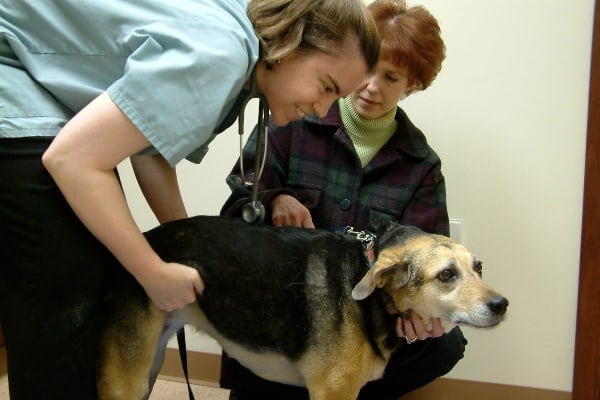
Sometimes you may see symptoms of Cushing’s disease and schedule a vet appointment. Other times, your vet may suspect Cushing’s disease after talking with you at an appointment. In either situation, the vet will select the diagnostic testing that he or she feels is right for your dog.
Testing to rule OUT Cushing’s disease
Sometimes, I recommend that my client starts with a simple and relatively inexpensive test called a urine cortisol creatinine ratio (UCCR). The UCCR test measures the ratio of cortisol (the hormone overproduced in Cushing’s syndrome) to creatinine (a normal component of urine).
Since cortisol is normally secreted in times of stress, for best results, the client should collect the dog’s urine sample at home, at least two days after a vet visit. This way, the dog doesn’t get anxious from a visit to the veterinary clinic, secrete a bunch of cortisol, and skew the results. Additionally, the first urine sample of the morning seems to provide the best results.
Before I run the test, I always want my clients to understand that the UCCR test rules OUT the diagnosis. But does not definitively rule it IN. In other words, an elevated UCCR doesn’t prove that a dog has Cushing’s syndrome. But a dog with a normal UCCR has a very low chance of having Cushing’s disease. Thus, the UCCR does a very good job of ruling OUT the diagnosis.
This may seem counterintuitive, but it’s actually quite valuable. If the UCCR is normal, we can cross Cushing’s off the list as a possible diagnosis. Then we can move on to figuring out what else could be causing your dog’s symptoms.
And if the dog has an elevated UCCR, this is an indication that we should perform more specific tests to confirm the diagnosis.
Testing to confirm Cushing’s disease
Tests to rule IN Cushing’s (i.e. confirm the diagnosis) are blood tests for dogs. There are three main tests—the ACTH stimulation test, a low dose dexamethasone suppression test, or a high dose dexamethasone suppression test.
ACTH stimulation test
The ACTH stimulation test involves drawing a blood sample to determine a baseline cortisol level. Then the vet will administer synthetic ACTH, which should stimulate the adrenal glands to release cortisol. In dogs with Cushing’s disease, post ACTH blood cortisol levels are usually elevated above what would be expected for a “normal” response to ACTH.
This test is positive in around 80-85% of dogs with pituitary-dependent Cushing’s disease and 60% of dogs with adrenal-dependent Cushing’s. It cannot distinguish between the two types. The ACTH stimulation test is, however, the test of choice for diagnosing iatrogenic Cushing’s disease.
Low-dose dexamethasone suppression test
For the low-dose dexamethasone suppression test (LDDST), the vet will draw a blood sample to obtain a baseline cortisol level. Then he or she will give the dog a low dose of the steroid dexamethasone. In a normal dog, the dexamethasone should tell the body to make less cortisol. However, in dogs with Cushing’s disease, a low dose of dexamethasone will not suppress cortisol production.
The test is positive in about 90% of dogs with Cushing’s disease. And about 50% of the time, it can distinguish between pituitary-dependent and adrenal-dependent Cushing’s disease.
High-dose dexamethasone suppression test
The high-dose dexamethasone suppression test is performed in the same basic way as the LDDST, except it uses a higher amount of dexamethasone. The goal of this test is not to determine if the dog has Cushing’s disease but to attempt to distinguish between the adrenal-dependent and pituitary-dependent forms. Sometimes it is able to do so, but not always.
Each of these three tests has some pros and cons. Your vet will select the one that he or she thinks is right for your dog. In some situations, your vet may recommend more than one of these tests. This is especially likely to be the case if he or she is trying to differentiate between the three types of Cushing’s disease.
Some dogs require further diagnostic testing
Occasionally, the results are still not conclusive. In order to nail the diagnosis, the vet may recommend an abdominal ultrasound to assess the adrenal glands. Or she or she may suggest an MRI or CT, further bloodwork, or other tests.
In addition to tests to rule out or confirm Cushing’s disease, your veterinarian may also recommend a urinalysis and/or urine culture. These tests look for evidence of urinary tract infections, which can be “silent” and accompany Cushing’s disease, especially in female dogs.
How is Cushing’s disease in dogs treated?
In most cases, Cushing’s is a lifelong disease that often requires daily treatment and careful monitoring by your veterinarian. It is a commitment and it can be daunting. However, the good news is that there are several treatment options to help your dog feel better.
Medical treatment for dogs with Cushing’s disease
Often, medications to control cortisol levels are the treatment of choice for managing a dogs with adrenal or pituitary-dependent Cushing’s syndrome long-term. (Treatment for iatrogenic Cushing’s disease just involves carefully weaning the dog off of steroids.)
Common medications used to treat pituitary or adrenal dependent Cushing’s disease in dogs include:
Vetoryl
Vetoryl® (trilostane for dogs) is currently the only veterinary-approved product on the market that treats both the pituitary and adrenal-dependent forms of the disease. It blocks the production of cortisol to bring cortisol levels back to normal.
While side effects of Vetoryl are fairly common, they are thankfully usually mild and only last for a few days. Some of the potential side effects include nausea (which can be decreased by giving Vetoryl with food), vomiting, decreased appetite, lethargy, diarrhea, or weakness.
Lysodren
Another treatment option is a drug called Lysodren® (mitotane). It targets the adrenal glands, which are over-producing cortisol. This medication keeps the glands from producing as much cortisol by selectively killing some of the cortisol-producing cells.
Typically, but not always, the vet will use a two-phased approach to treatment. The first phase, induction, uses higher doses of Lysodren. It is important to watch your dog carefully, especially during this phase. If your dog isn’t eating as much, has vomiting or diarrhea, becomes lethargic, or isn’t drinking enough water, promptly contact your vet. Those symptoms indicate it may be time to switch to the maintenance phase, which uses lower doses of mitotane long-term.
Overall, dogs in either phase may experience side effects such as decreased appetite, lethargy, weakness, vomiting, or ataxia (i.e. unsteady gait). If you see these side effects, it is best to check in with your vet.
Selegiline, ketoconazole or melatonin
Selegiline for dogs, a drug used to manage canine cognitive dysfunction, is also approved to treat the pituitary-dependent form of Cushing’s disease. Also, there are some off-label medication options for Cushing’s disease such as ketoconazole and melatonin for dogs.
However, melatonin and ketoconazole are not approved to treat Cushing’s disease. So they must be used with care and with the understanding that they may not be effective. Plus, if you choose to try melatonin for your dog with Cushing’s disease, please be aware that some products, especially melatonin gummies, may contain xylitol, which is toxic for dogs. Always check the label for xylitol (i.e. birch sugar) before giving melatonin to your dog.
Surgical treatment for adrenal-dependent Cushing’s disease
Additionally, if an adrenal tumor is the cause of the Cushing’s, the affected gland can be surgically removed. This is not a simple surgery and is ideally performed by a board-certified surgeon. Risk of hemorrhage from surgical removal of the gland is significant, as is the risk of other post-operative complications.
Depending on the study you look at, between 10% and 25% of patients may not survive surgery and post-op period. Thus, many pet parents opt to treat their dogs with medical management to avoid the cost and risk of surgery.
What sort of monitoring do dogs with Cushing’s disease require?
It is important to know from the outset that dogs taking medications such as Vetoryl or Lysodren require close monitoring with frequent lab work.
Sometimes these medications can work TOO well and cause the opposite condition—hypoadrenocorticism (i.e. Addison’s disease in dogs). If you notice signs of Addison’s disease such as vomiting, diarrhea, lethargy, tremors, or loss of appetite, contact your veterinarian immediately. Addison’s disease can be life threatening, so it is critical your dog gets veterinary attention right away.
On the other hand, if it seems like your dog’s Cushing’s symptoms aren’t resolving, or if they go away and then come back, you should also give your vet a call. This may be an indication that the Vetoryl or Lysodren dose isn’t sufficiently controlling your dog’s Cushing’s disease. Or it could mean that your dog has developed a concurrent condition with similar symptoms, such as diabetes in dogs.
In addition to monitoring your dog’s symptoms, you will need to bring your dog back to the vet periodically for an examination and follow-up bloodwork. This is important so the vet can determine how well the medications are working.
In the interest of full disclosure, these vet visits can represent a significant financial and time commitment. When initially starting therapy and when making dose adjustments, your vet may need to examine your dog and run bloodwork as often as every few weeks or months.
How can I help comfort a dog with Cushing’s disease?
In addition to treating your dog’s Cushing’s disease and keeping up with the necessary monitoring, here are five more things you can do to be vigilant in managing your dog’s condition.

1. Keep your dog’s water bowl full of fresh clean water
Always have fresh water available. As I mentioned, Cushing’s causes increased thirst and urination, so your dog will want to drink more and need to go out frequently for potty breaks. Make sure you refill the water bowl often and give your dog plenty of opportunities to go potty.
2. Be on the lookout for signs of skin problems
Keep a sharp eye on your dog’s skin. If you notice signs of skin infection such as bumps, crusts, hair loss, or red irritated skin, speak with your vet. It is important that skin infections are addressed promptly. In some cases, your vet may also prescribe antifungal and antibacterial shampoos and wipes to proactively help combat skin infections.
3. Know how to recognize the signs of a UTI
Watch for signs of urinary issues such as increased frequency of urination, foul odor to the urine, straining to urinate, and/or blood in the urine. If you observe any of these signs, take your dog to your veterinarian. For dogs with Cushing’s, urinary tract infections are nearly impossible to prevent. However, you can help your dog by seeking treatment promptly.
4. Partner with your veterinarian
Keep in close contact with your veterinarian about any changes in your dog’s symptoms. You see your dog every day and know your dog better than anyone else. So you are in the perfect position to spot signs that may signal you dog has flipped over to having Addison’s disease or indicate the medications aren’t working. Trust your instincts and reach out to your vet if you have any concerns.
5. Address mobility issues due to Cushing’s disease
If your dog is having mobility issues due to muscle wasting, look for options to minimize discomfort and falling. I recommend the following to many of my clients:
- Keep your dog on carpet
- Avoid slick floors
- Learn how to relieve arthritis pain in dogs
- Choose a soft bed for your dog’s comfort (Consider a memory foam dog bed)
- If possible, avoid stairs
- Consider laser therapy for dogs and physical therapy
- Teach your dog to use ramps
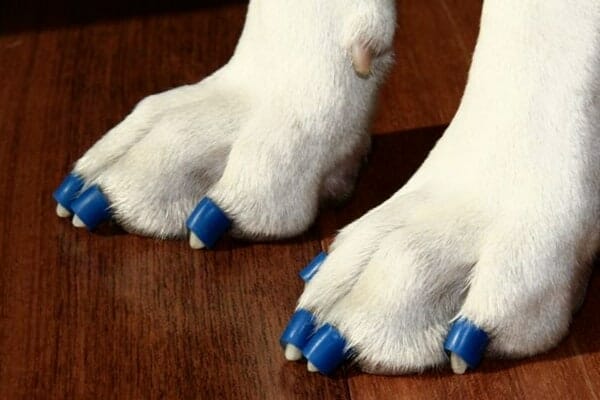
- Additionally, I’ve had many patients with muscle wasting due to Cushing’s syndrome thrive using ToeGrips® dog nail grips. The non-slip grips fit on dogs’ toenails to improve traction on hardwood floors, preventing sliding and falling.
Is my dog in pain with Cushing’s syndrome?
While you are thinking about how to keep your dog with Cushing’s disease comfortable, it is understandable to wonder if Cushing’s syndrome is painful. Thankfully, Cushing’s disease doesn’t cause pain in dogs in the traditional sense of the word. It isn’t like a torn ACL in dogs or intervertebral disc disease (IVDD) in dogs. However, I would argue that it can negatively impact quality of life. Hear me out.
Dogs with uncontrolled Cushing’s disease are thirsty all the time and need to urinate frequently. Sometimes they may have accidents in the house if they can’t make it outside in time. That can be hard on a dog’s dignity. It may also be more difficult for them to rest peacefully since they are prone to panting and pacing.
We can’t know for sure the emotional impact those changes have on a dog. And I’ve seen hundreds of “untreated” Cushing’s patients over the years who seemed fine. However, living with symptoms of Cushing’s is not ideal for the dog nor their family. The good news, though, is that treating your dog’s Cushing’s disease will help get those symptoms under control. This can greatly improve your dog’s quality of life.
What is the prognosis for dogs diagnosed with Cushing’s disease?
The prognosis and life expectancy for dogs with Cushing’s disease can vary depending on which form of Cushing’s disease they have and how well they respond to therapy.
Life expectancy for pituitary-dependent Cushing’s disease in dogs
With pituitary-dependent Cushing’s disease, the moderate-term prognosis is good with treatment. Median survival time (i.e. the point at which 50% of dogs with the condition are still alive) is 2 – 2.5 years. Most of the time, the majority of the clinical signs will go away quickly after starting medication. But it may take about three months for the skin-related signs to resolve. And sometimes symptoms like calcinosis cutis don’t fully disappear.
Unfortunately though, there is a small number of dogs with pituitary-dependent Cushing’s who don’t respond as expected to treatment. Thus, their prognosis may be worse. Additionally, if the dog has a large pituitary tumor rather than the more common tiny tumor, the prognosis is also worse. This is especially the case if the dog is showing any neurological abnormalities.
Life-expectancy for adrenal-dependent Cushing’s disease in dogs
For adrenal-dependent Cushing’s, the method of treatment and whether the tumor was benign or malignant (i.e. cancerous) both impact prognosis and life expectancy. Benign tumors and those that are small and less invasive usually carry a better prognosis. Overall, the median survival time is 1.5 – 4 years (depending on the study) with surgical removal of the tumor. But average life expectancy is closer to one year with Lysodren or Vetoryl therapy.
Concurrent conditions may impact quality of life
Additionally, your dog’s prognosis for either form of Cushing’s disease will also depend on any other conditions your dog may have. If your dog has concurrent medical problems such as diabetes or arthritis, the symptoms from those problems can compound with the symptoms of Cushing’s or make Cushing’s harder to manage. This can contribute to a decline in quality of life.
Knowing when it is time to say goodbye
Despite the fact that dogs with Cushing’s disease have a reasonably high chance of having a good year or several good years, the time may eventually come when you need to consider when to euthanize your dog with Cushing’s disease.
Some dog parents may start preparing for their dog’s euthanasia when they begin to see symptoms of advanced Cushing’s disease that are not controlled by medication. Others may decide to say goodbye because their dog is no longer taking pills well or tolerating the frequent vet visits. Or dog parents may know it is time when the financial toll or pet caregiver fatigue become too much to bear.
Sometimes it may also be a different medical problem, not the final stages of Cushing’s disease, that ultimately mean setting your dog free is the kindest course of action.
There isn’t one universally right time or right reason to make that decision. But your trusted veterinarian and your close friends or family members can help you determine what is right for your dog and your family. And they can help support you as you grieve the loss of your dog.
Don’t lose hope
I know that these statistics and the discussion of the final stages of Cushing’s disease and when to say goodbye may seem grim. But I want you to know that Cushing’s disease in dogs is not a hopeless diagnosis. Yes, your dog may need a risky surgery or daily medication and frequent rechecks with the vet. But once Cushing’s disease is under control, your dog can often have an excellent quality of life for years. And that is huge.
Let me remind you too that you can play an important role in your dog’s health. Watching him or her carefully for symptoms, keeping up with all medication monitoring appointments, and working closely with your vet can all help your dog feel his or her best despite having Cushing’s disease.
This is exactly the pep talk I gave to Jake’s mom when I diagnosed my sweet senior Lab patient with Cushing’s disease. I’m optimistic that he has several happy years ahead. And I look forward to partnering with his mom to provide him the longest, healthiest life possible. The same may be true of your dog too. So don’t lose hope!
What questions do you have about Cushing’s disease in dogs?
Please comment below.


My 9yr 9mo old male neutered Yorkie Shi tzu cross was diagnosed last fall with Cushings and started Vetoryl (40mg) right after diagnosis. He is 19lbs which is 6lbs over his ideal weight. He is negative for diabetes. He is still panting, on walks mainly, but has had a few recent nights with heavy panting. His blood work was last done in January 2025 and I requested a vet visit because of the excess panting still. My vet suggested an adrenal ultrasound and chest X-ray but after reading your article I am hesitant to do either in favor of updated bloodwork. I’m also considering seeing a different vet who was just highly recommended since my current vet also suggested anti anxiety meds. What are your thoughts? I appreciate your suggestions. Thanks.
Hi Theresa,
I understand your concern for your senior guy. I wish I could offer some helpful advice, but without playing a personal role in your dog’s medical care it is hard to make specific conclusions and recommendations. While changes in body function can definitely cause the increased symptoms you are seeing, it is also possible that this is just a normal progression of the Cushing’s disease. A chest x-ray would be good to rule out lung lesions or an enlarged heart, and you may want to discuss the benefits of an abdominal ultrasound. You are doing a great job advocating for your boy. Hoping you can get to the bottom of this puzzling situation and find the best way forward.
I have a 15 and a half female Dachshund that was diagnosed with Cushing’s 2 and a half years ago via acth testing and an atypical panel from Texas A&M. She doesn’t look like a typical cushing’s dog (doesnt have the hair loss) and even seeing numerous vets, holistic vets and internal medicine no one has been of any help, don’t want to believe she has cushing’s, etc. They see her alp is normal and think that has to be up which I know isn’t true. She does has very dilute urine. She has many of the listed symptoms including the excessive hunger and water intake so it baffles me that I get the run around just because she doesnt have a potbelly or hair loss (although her ears can at times). There are things on her labs that scream cushing’s like high platelets, low bun, etc. yet they ignore it. She’s a Dachshund and they are notorious for cushing’s too. I’ve spent as much as a house mortgage to get nowhere. A big issue is she has cocurrent GI issues and highly suspected lymphangiectasia on ultrasound, can get pancreatitis flares for all kinds of reasons including the cushings and has such a sensitive stomach so medication is out and I have tried natural supplements that just caused more gi issues. Even finding a diet that doesnt give her issues has been a brick wall for 4 years. Even probiotics can actually make symptoms worse. Lately she’s been having more anxiety and back leg issues. I’m starting to see more neuro issues which I’m pretty sure are focal seizures so pretty sure she has an expanding tumor. (she has a history of a head tilt that comes and goes). There are times when she seems very full of life playful, etc. to the point you would think she was 8 again with nothing wrong and other times the opposite. Its a sad disease because I don’t want to call things too early or too late. My other Dachshund I lost at 12 because of a vet making a huge mistake was diagnosed with the same thing. I don’t think he truly had cushing’s though because he most likely had intestinal lymphoma. Just last week she was full of it not really having issues moving, but then started to get stool issues again so I gave her Tylan for a day which solves the stool issues, but of course alters her biome then I see everything else get worse including her joints and restless at night. Her dysbiosis has been a big issue and know stress can affect that too. What’s tough for me is if I have to let her go soon how to I knock her out or calm her down to where she doesnt know what’s going on? The last thing I want is someone coming here, she gets all happy or has anxiety and freaks out with someone trying to touch her. I dont want her last moments to be in a panic. The vet world has really been a huge let down for me though to the point I’ll never have another dog. They milk me for money and I get no answers or any real help.
Dear Nate,
I am so sorry for all you and your senior girl have been through. I hear your frustration over how things have been handled. Unfortunately, your pup sounds like a very complicated case and her test results are confusing and not straight forward. I can see how this would be a challenge for any vet (including myself). It is true that quality veterinary care is not cheap, and it can take some time to work through all the possible causes and issues. I highly recommend you reach out to a hospice/in-home euthanasia veterinarian in your area. They can walk you through planning these final days for your girl. Luckily, there are some great options for medications that can be given the night before and the morning of the planned “goodbye” to help your pup relax and minimize stress and anxiety. There is no reason her passing can’t be smooth and peaceful. I will attach links to other articles with more information. Praying for comfort and strength for the emotional days ahead.
1. Dog Hospice Care Can Bring Peace and Dignity to Your Dog’s Final Days
2. In-Home Dog Euthanasia: Heartfelt Answers to 12 FAQs
3. Preparing for Your Dog’s Euthanasia: 10 Thoughts for Peace
I got to looking up symptoms for my lil biddy and Cushing’s fits all her symptoms to a tee i called the vet about her and way she has been doing. her weight has doubled in a year. from 11 to 22.5 lbs but sh engorging on food and water as soon as she drinks. she pees a bunch rt by water bowl so I use pads near water bowl anyway the vet said to me she has had a long 14 years. maybe time to put her to peace I don’t feel that rt. or even human she hasn’t seen her. hasn’t looked if it is Cushing’s id say it’s the later stages what do I do find a nother vet keep her comfy or what
Hi Amy,
I am sorry you are facing this difficult situation with your pup and understand your concern. Whether you decide to pursue testing and treatment or want to choose comfort/palliative care is really up to you. You have to trust your intuition and follow the path that will bring peace to your heart. Even if your vet does not think it is the best route, they should still be willing to move forward with testing and treatment if that is what you want. It is also perfectly ok to get a second opinion or become established with a different vet if you feel your current situation is not a good fit. Praying for your strength and a clear path forward. Bless you and your sweet girl.
My 10 year old, 15 pound dog is on 60mg of trilostane. He went from 30mg, to 50mg, to 60mg and has been on it for close to a year.
I didn’t have tests to confirm which type of cushings he has since both are typically treated the same minus surgery. He circles and seems to “get lost”. I’m wondering if trilostane can be combined with selegilene to help with his cognitive function?
Hi Amy,
I am sorry your pup is starting to show signs of cognitive decline. Honestly, I am not sure if those two medications can be combined safely but your vet should be able to look into it or consult a specialist if needed. There are other ways to treat the dementia and help improve cognitive function. I will attach links to other articles with more information. Your boy is very lucky to have you advocating for his health and well-being. Wising you both all the best.
1. Signs of Dementia in Dogs: Stages, Symptoms & Treatment
2. MCT Oil for Dogs Can Help Dogs with Dementia or Epilepsy
3. 13 Mental Stimulation Toys for Dogs (& Activities Too)
4. Exercise & Enrichment for Senior Dogs Boosts Brain Health
hello, I am not sure if I did wrong and guilty to let my 16 yrs old Yorkie last month. it seems like he is ok and everyone else seeing it seems like there’s nothing wrong with him. so this is the start: last yrs I noticed his coughing like not really serious. I haven’t taking to see the veterinary. I taught maybe he had allergy or asthma and he ate a lot, drinking water constantly. and he is so picky when it comes to food. So this year May, I decided to take him to see the vet and see what’s going on this coughing and eating and drinking lots of water. The veterinary said needs to get some tests. so I made a choice first about coughing issues. bcuz I can’t afford yet with two tests. finally the results of coughing is bronchitis. gave me steroids and medicine for cough. so I followed the instructions. all medicine are gone and it seems like it doesn’t work at all. in fact he got worse! so I called the vets again and explained. she told me pick up the Rx and take to pharmacy the medicine is FLUTICASONE for inhaler 2 pop a day. and while I was there I decided to get his test for eating and drinking a lot. the results is cushions diesese. I asked is there any medication or diet or should I hiding the water from him? she said, no medicine and just makes sure the water always fresh and not empty and he still can eat. ok I followed what she said. on the 22nd of August I gave him the pop proscribed me. about 3 days or 4 days, he started losing appetite or not eating much. I said to myself. GREAT. but down the road he doesn’t want to eat much, even though his favorite treat doesn’t like it. so I decided to stop giving the inhaler medicine. but don’t give me wrong, the coughing is stop. so I called the veterinary and explained. she said, bring it back here and get another test. I said what test again? and I even asked her if she can proscribed me vetoryl. bcuz one of my neighbor dog have cushions diesese too. she said, she can’t give to me till I bring my dog back. I asked how much are we talking again. $1150 I’ve been thinking should I bring him back with the same veterinary? in the meantime, I went back to my own vets and asked if there’s any medication for my dog eating. by the way, she knows everything what’s going to my Yorkie, but they can’t handle this kind of situation. so she gave me medicine to get my dog back to eat or getting him appetite. and it works. but he don’t eat much like before. so I stop giving to him for while, bcuz I don’t want to depend the medicine. he still eating, but less, until he doesn’t want to eat again. so Everytime I gave that medicine, he ate just very little but still drinking lots of water. till don’t to eat anymore just water. his getting weak I know. and his still panting. Now, my question is, did I make a huge mistake by not taking him back to the doctor and let him sleep September 16th?
Dear Minerva,
My heart goes out to you as you face this difficult situation with your senior pup. I wish I could offer guidance and advice, but without playing a personal role in your dog’s medical care I can’t give specific conclusions or recommendations. I do think you need to talk to your vet and have an honest discussion about your concerns and wishes for your boy. I am hoping you can partner together to find the best way forward and restore your sweet boy’s quality of life. Bless you both.
Hi! My Lhasa Apso (intact female) was diagnosed with Cushings but the vet wants to take her OFF vetoryl to run a secondary test to see if her Cushings is caused from secondary sex hormone overproduction because she’s not fixed. She has CLASSIC symptoms, and responded well to Vetoryl. Is this secondary test worth it? What is the likelihood the sex hormones are the true cause of her Cushings?
Hi Brynne,
I understand your concern and confusion over this situation. To be honest I cannot figure out exactly what your vet is recommending. I am not saying that what they propose is wrong, but just that I don’t have enough information to offer an opinion. Just remember that no matter what, you have the final say and you need to feel comfortable and confident with your dog’s medical care. If you would rather forgo additional testing and continue giving the Vetoryl as previously prescribed, don’t hesitate to speak up and make your wishes known. Hoping for a clear path forward and wishing you and your sweet girl all the best.
Hi,
My 8 month old GSD has been drinking and urinating excessively for 8 days now and messing in the house at night. We’ve had him on antibiotics for 7 days with no improvement so he saw the vet again today. She suspects he has Cushings. He is incredibly active, he wants to play all the time, his appetite is great. All in all, he appears to be a very healthy, slightly overactive pup with some anxiety issues, He is having tests tomorrow morning but is Cushing’s disease normal for puppies and is their prognosis any better or worse than for older dogs??
Thank you,
Gayle
Hi Gayle,
I understand your concern for your young dog as he continues to exhibit these worrisome symptoms. Cushing’s is not normally diagnosed in puppies but that doesn’t mean it isn’t a possibility. There are also other conditions that could be contributing such as a congenital abnormality or even diabetes insipidus. Don’t forget you can always ask for a consultation with an internal medicine specialist if needed. They have lots of experience dealing with complicated or unusual cases. Hoping you can get some answers and find a clear path forward with treatment. Wishing your sweet boy all the best and praying for a positive outcome.
Hi
My 11 year old Frenchton was diagnosed with cushings in Jan. After the first vet prescribed 30 mg of Vetoryl once a day, which ended in my dog vomiting profusely, elevated heart rate and shaking (after just 1 pill) I stopped the meds, waited 3 weeks and had another vet prescribe 10 mg twice a day. 2 hours after the first dose, the skin on her back thickened and you could see skin rolls. Vet didn’t seem concerned. Within a week the hair in her back fell out with sores sprouting up. She has since been diagnosed with calcinosis and a bacterial infection. But literally 2 hours after taking Vetoryl, is when this started. Not a small spot but a sheet of it all down her back. Have you ever seen this? Her levels tested perfect after 3 weeks on Vetoryl, so the disease has been managed but her skin is out of control and getting worse. No other cushings symptoms. This has been heart breaking to see how uncomfortable she is. Just feel like the vets are missing something.
Dear Kimberlee,
I am sorry your senior pup is experiencing these terrible symptoms. They do sound like a progression of Cushing’s rather than side effects of the medication. I am not sure what advice to offer or how to guide you in this situation. It is hard to help without being personally involved. It may be time to ask for a referral to a specialist in order to get the answers you need. Hoping for a definitive diagnosis and a way to offer your pup relief. Bless you both. ♥
Good afternoon, I have a 10 yr Papillon mix female spayed. For 2 years she has had slightly enlarge heart. Enlarged liver with High liver enzymes . Several bouts of pancreatitis, 1st one after knee surgery. Bile in gallbladder.
Occasionally high pancreatic levels. She has always bern a very low key dog. Has an increased appetite for several years now. Thinks she hungry all the time. Always drinks a lot. No vomiting or diarrhea. Lately her hair is falling out but skin looks good , not red, except for areas by all elbows. She used to have a big gorgeous tail now it’s very thin.
Has trouble getting up through doorways or patios. Pants and does have a potbelly look. We have a language barrier with her vet team but I do trust them for her care. Does it sound like she might have Cushings now.. She has been on Cardial B (heart) fluid pill (lungs) denysol, Ursodial, joint supplements, Proteliv,Dasuquin. She doesn’t seem like she’s suffering but she doesn’t complain.She has slowed down recently .I’m not sure how long I should be treating her with all these meds.
Thanks Teresa
Hi Teresa,
I am sorry you are facing this difficult situation with your senior girl. I understand your concern for her health and well-being as she is dealing with so many issues at once. From what you describe, it is possible she has also developed Cushing’s disease. This might be worth discussing with your vet to see if they think testing is needed. At some point the bad days will start to outweigh the good and you will have to make some tough choices about your girl’s quality of life. I encourage you to trust your intuition as you know her better than anyone. Praying for clarity and a clear path forward. Bless you and your sweet girl.
Hi doctor, Our Leeloo is a mixed breed rescue. probably lab / golden/ ridgeback/…we’ve had her since a pup. anyway just recently at almost 10 yrs old shes developed what appears to be Cushings. were bringing her in for a day long observation and test with the various meds to rule out or confirm the disease. along with her symptoms shes gone almost completely blind! onset was rapid. Were thinking perhaps due to a tumor? if treatment for the cushings is successful is there the possibility of her eyesight returning. our vet calls the blindness sudden retinal detachment syndrome. I do see some reaction in her eyesight and her pupils do react to light. what do you think?
Hopeful
Dear Greg,
I am sorry Leeloo may be facing a Cushing’s diagnosis. Unfortunately, once there have been changes to the eyes, they are usually permanent or would need surgical intervention (as with cataracts). If your girl does in fact have sudden acquired retinal degeneration syndrome (SARDS) then this is permanent and has no treatment. Most dogs adjust well and go on to live happy lives despite the blindness. Here is a link to another article with more information: SARDS in Dogs: Sudden Acquired Retinal Degeneration Syndrome
How did the Cushing’s testing go? Were you able to get a definitive diagnosis? Hoping Leeloo is doing well and wishing you both all the best.
hello, I have a Minnie doxie with Cushing’s petuatary DEP. diagnosed just over 2 years, he is on vetoryl 20 MG’s gabapentin 100mgs 2xday plus trazodone 2xday for anxiety he has head seasures often through the day some make his head go way back month opening yelp falls over takes a minute to get his barrings , circles diggs hunger not under control,thirst starting to pick up and peeing in the house, don’t know when I should say good by as he still gets bursts of energy , I am 73 on fixed income in government subsidies housing, vet bills are thousands of dollars a year ,just meds alone $3,000 not counting other needed blood work or issues , I’m at a loss he is my life and don’t want him to hit bottom but feel guilty , any help or advice is gratefully appreciated 🐾💜
Dear Dian,
I am sorry you are facing this difficult situation with your little pup. I understand how hard it is to evaluate quality of life and know that choosing when to say goodbye is emotional and confusing. It is ok to let go before all joy is lost and the only thing that remains is pain and anxiety. I would rather say goodbye one day too early than one day too late and allow unnecessary suffering. Please don’t feel guilty for considering your own well-being and finances. Your quality of life matters too! I will attach links to other articles with more information and great advice from other readers as well. I pray for your comfort and peace. Bless you. ♥
1. When To Euthanize A Dog With Cushing’s Disease: A Vet’s Advice
2. Using a Quality of Life Scale for Dogs
3. When Caring For A Sick Pet Becomes Too Much: Pet Caregiver Fatigue
4. Preparing for Your Dog’s Euthanasia: 10 Thoughts for Peace
I am a senior on a meagre fixed income. My Maltese was diagnosed with Cushings 1-1/2 yrs. ago, but I am still paying off the initial blood test and cannot afford any further treatment. So far, she still seems to be happy and lively. How much longer can I expect to have my precious furbaby with me weithout treatment?
Hi Caren,
I am sorry you are in this difficult situation with your pup. I understand how hard it can be when finances limit the options despite wanting to do what is best for your girl. The statistics say that dogs live 1-2 years after diagnosis, but I have had patients that exceeded this timeframe by several years. Ultimately, there is no way to know how long your girl will live. Focus on her quality of life and as long as she is happy and joyful, I’d say you are doing a great job. Wishing you both all the best for many years to come. Bless you and your sweet girl. ♥